|
Icon
|
Project type and supervisor
|
Project title and brief description
(Click title for details) |

|
Data analysis with
Adam Kobelski
and
Roger Scott
|
Probing Magnetic Reconnection with Active Region Transient Brightenings
Solar magnetic reconnection happens on a variety of scales. Active Region Transient Brightenings (ARTBs) are small scale energy release events governed by
magnetic reconnection. Student will search these events using
soft X-ray observations by SXT and XRT, and analyze and model
these events as a bundle of unresolved strands formed and heated independently.
|

|
Data analysis with
Dana
Longcope
|
Computing the Magnetic
Energy of the Sun's Magnetic Field
Solar flares occur when a large amount of magnetic energy is converted into
plasma thermal and kinetic energies. The amount of this energy stored
in the Sun's magnetic field must be calculated by extrapolating the magnetic
field from the photosphere upward. In this project the student will use a new technique
to trace the magnetic field lines visible in an EUV image, from the SDO
spacecraft, and then use these to compute an estimate of the magnetic energy.
|

|
Modeling with
Dana
Longcope and Sean Brannon
|
Evaporation Driven by Thermal Conduction
Fast magnetic reconnection releases energy by shortening magnetic flux tubes rapidly, thereby rapidly compressing the plasma they contain.
This compression is rapid enough to be super-sonic and thus generates a shock, the most well-known feature of fast magnetic reconnection.
Thermal conduction moving ahead of the propagating shock can drive evaporation from the chromosphere and transition region.
In this project, we will use a one-dimensional hydrodynamic code to explore the effect of magnetic field geometry at the lower-atmosphere
on evaporative upflows driven by shock-initiated thermal conduction fronts.
|
|
Data analysis with
David McKenzie
|
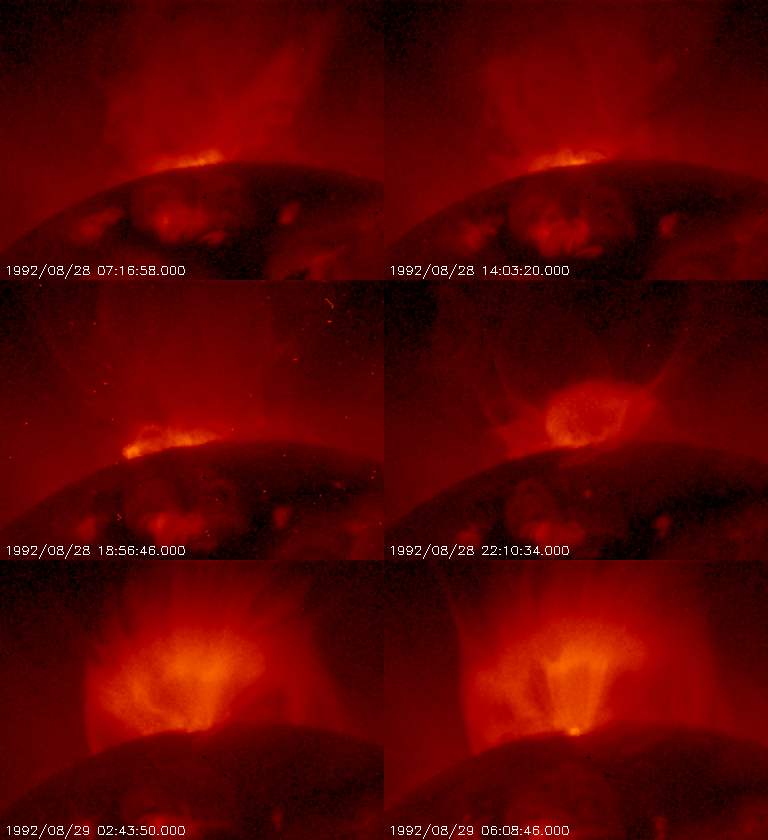
Study of Sheet Structures in Eruptive Solar Flares
Observations of high-energy emission from solar flares often reveal the
presence of large sheet-like structures, sometimes extending over a space comparable to the Sun's radius.
These sheets exist in a very important region where the magnetic field is expected to produce
large sheets of electrical current. In this project, we will measure the physical conditions in sheets
to understand how these conditions control the magnetic reconnection and energy release in flares.
|

|
Data analysis with
Jiong
Qiu
|
Inferring Magnetic Reconnection from UV Signatures in Flares
Flares are spectacular energy release events governed by magnetic reconnection.
The student will study the evolution of flare radiation signatures
at the foot-points of magnetic tubes (loops) formed during reconnection,
measure parameters of magnetic reconnection, and search for
better understanding of the relationship between magnetic reconnection
and energization of plasmas or particles in flux tubes.
|

|
Hardware development with
David
Klumpar
|
Space Hardware Development: Space Flight Systems for Space Science
MSU's Space Science and Engineering Laboratory (SSEL) involves students in highly responsible
roles in science and engineering associated with the development of space flight systems for
scientific applications. The student(s) will develop spaceflight hardware through design,
development, and testing as a member of an interdisciplinary project student team. Participants must be U.S. citizens.
|