Physical Quantities Obtained from
Some results of the restoration of the observed images of Yohkoh SXT has been presented and discussed. Undersampling effect included in both observed images and the PSF produces mathematical artefacts in the deconvolved images. Thus, in order to overcome this kind of problem, the sampling density has been increased prior to performing the deconvolution. Simple iterative algorithm of maximum entropy method together with the adaptive filter is applied to the restoration of the densely-sampled SXT images. Using the filter ratio method, some physical parameters of solar coronal plasma have been calculated. Results of the restoration and the calculation of the parameters for the example images will be introduced and discussed.
I. Introduction
Improved performance of the Soft X-Ray Telescope (SXT) aboard Yohkoh (Tsuneta et al. 1991) allows us to discover the details of three dimensional magnetic field structures including coronal loops, flares, and mass ejections in the solar corona. Aside from morphological studies, one of the purposes of using the Yohkoh SXT images is to study the spatial or temporal variations of many physical quantities like intensity, emission measure, plasma temperature, etc., and interpret the mechanism of coronal activities. Therefore, calibrations on the observed images should be carried out very carefully. Numerous methods for the calibration of the observed SXT images have been proposed, and those calibrated images are used in the interpretation of the physical state of the coronal plasma. However, in spite of many procedures for detailed calibrations, the images observed by Yohkoh SXT still do not present sharp enough structures of the solar corona because of the finite resolving power of the telescope. It is because what is recorded by the CCD is the result of the convolution of the real X-ray intensity distribution of the solar corona with the blurring pattern by the telescope mirror. The blurring pattern on the grazing incidence mirror of the SXT, i.e., the point spread function (PSF), can be described by the Moffat function for the core (Martens et al. 1995), and the power-law gradient for the scattering wing (Hara et al. 1994), respectively. Though the level of the scattering wing for the SXT mirror is much reduced compared to the Skylab SO-54 telescope, there is no doubt that the convolution blurs the original feature of coronal structures, which has made us feel that the observed images should be improved via deconvolution. However, the subtraction of this blurring effect inherent in the observed images has not been correctly performed for years, though many other image handling processes for the SXT data are still being developed and updated. It is because the images of Yohkoh SXT cannot be properly deconvolved by general algorithms of restoration. Consequnetly, it is believed that the deconvolution of the observed Yohkoh SXT images should be studied and performed for obtaining correct information on the solar corona.
II. Deconvolution and the Undersampling Effect
Shin(1998) has shown from the simulations that one of the major reasons that make the deconvolution difficult is the undersampling effect included in the observed images and the PSF. A large pixel size of the CCD installed in the SXT camera records the information from the solar surface poorly sampled. It was revealed from the ground experiment (Tsuneta et al. 1991; Martens et al. 1995) that the FWHM of the PSF of Yohkoh SXT is only as small as 1 pixel size (2.45 arcsec). Aside from the loss of resolution, it is clear from the simulation that it produces a mathematical artefact during the deconvolution. And it is believed that this kind of artefact is the mechanism of producing the negative structures in the deconvolved images.
In order to overcome this kind of mathematical problem in the deconvolution, it is necessary to remove the undersampling effect from the observed images. A method of variance optimization (Shin 1988) has been applied to the observed images for increasing the sampling density in the observed images. At the same time, the pattern of the PSF should be reconsidered for the deconvolution of the densely-sampled images. We have re-analyzed the data achieved from the ground experiment and determine the shape of the central part of the PSF. The result shows that the PSF has a shape slightly shaper than the measurement by Martens et al. (1995), and is smoothly connected to the scattering wing at the distance of about 20 arcsec from the center.
Since the scattering component of the SXT PSF will have a wavelength dependence, different types of PSFs should be used in the deconvolution of the images from different filters separately. In order to determine the scattering components for different filters, it is necessary to measure the mirror characteristics for finding the wavelength dependence. First-order vector perturbation theory (de Korte and Laine 1979) has been adopted for describing the three dimensional distribution of the scattered light. And star burst images, in which the location of the bright flare was burnt out due to the unintentional overexposure, are used for the determination of the scattering characteristics. It is revealed from our study that the scattering wing shows approximately a power-law dependence on the wavelength.
III. Restoration of Yohkoh SXT Images
An algorithm of Agmon et al. (1979) has been used for the restoration of the observed images. This method provides an alternative to the conventional procedure which requires the numerical solution of a set of implicit nonlinear equations for the Lagrange multipliers. Here it is determined by seeking a minimum of a concave function, a procedure which readily lends itself to computational work. One of the interesting points in the restoration of the SXT images is that the noise components are hardly suppressed during the iteration procedure. Though the sampling density is increased for the observed images, still the size of the noise components and the FWHM of the PSF is almost the same as that of the original pixel. In this situation, it is difficult to expect a successful removal of the noise components when the normal restoration algorithm is applied. For this reason, a shift-variant filter has been applied to the restoration algorithm, and each size of the filter for a certain location is naturally determined with satisfying the condition that all the pixels be of averaged intensity which is equivalent to 600 DN. In that case, for example, the temperature obtained from the restored image will show an error range of about 10% (Yoshida et al. 1995).
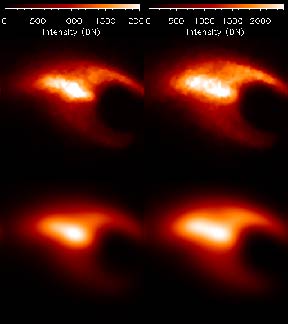
Figure 1 shows the results of the restoration for the images of the LDE flare
observed at Feb. 21, 1992 (Hara et al. 1992). Though the noise components are
suppressed in the dark areas to an extent,
it seems the blurred components still remain
in the restored images. It must be related to the fact that the
scattering level considered in our study might be underestimated.
Thus it is necessary to consider the more detail
description on the distribution of scattering wing of the SXT PSF.
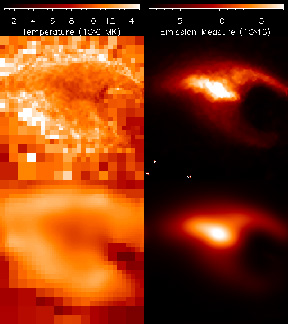
Using the filter ratio method, the plasma temperature and the emission
measure inside the LDE flare has been calculated (Figure 2).
Due to the regularization of the noise components inherent in the observed
images, the fluctuating distribution of temperature is now vanished.
But there are some structures in the hot region of the flare, which is small and smooth, but uncertain.
Indeed is it hard to suppress the noisy components included in the dark
area satisfactorily, even though we apply any of restoration algorithms
so far studied. Besides, the edge effect becomes another problem that
happens when the deconvolution procedure is performed.
It is shown from the figure that the outside of the flare region shows
the higher temperatures than the inside. But
it can be easily notified from the results that the physical quantities
obtained from the dark regions on the restored image are very sensitive
to the consideration of the level of the scattering of the PSF.
References
Agmon, N., Alhassid, Y., and Levine, R. D. 1979,
J. Com. Phys.,
30, 250
Hara, H., Tsuneta, S., Acton, L. W., Bruner, M. E., Lemen, J. R., and Ogawara, Y. 1994,
PASJ, 46, 493
Hara, H., Tsuneta, S., Lemen, J. R., Acton, L. W.,
McTiernan, J. M. 1992,
PASJ,
44, L135
de Korte, P. A. J. and Laine, R. 1979,
Appl. Op.,
18, 236
Martens, P. C., Acton, L. W., and Lemen, J. R. 1995,
Solar Phys.,
157, 141
Shin, J. 1998,
PhD Thesis, National Astronomical Observatory
Tsuneta, S., Acton, L., Bruner, M., Lemen, J., Brown, W., Caravalho, R., Catura, R.,
Freeland, S., Jurcevich, B., Morrison, M., Ogawara, Y., Hirayama, T., and Owens, J.
1991, Solar Phys., 136, 37
Yoshida, T. and Tsuneta, S. 1996, ApJ, 459, 342