Dynamical evolution of emerging field lines

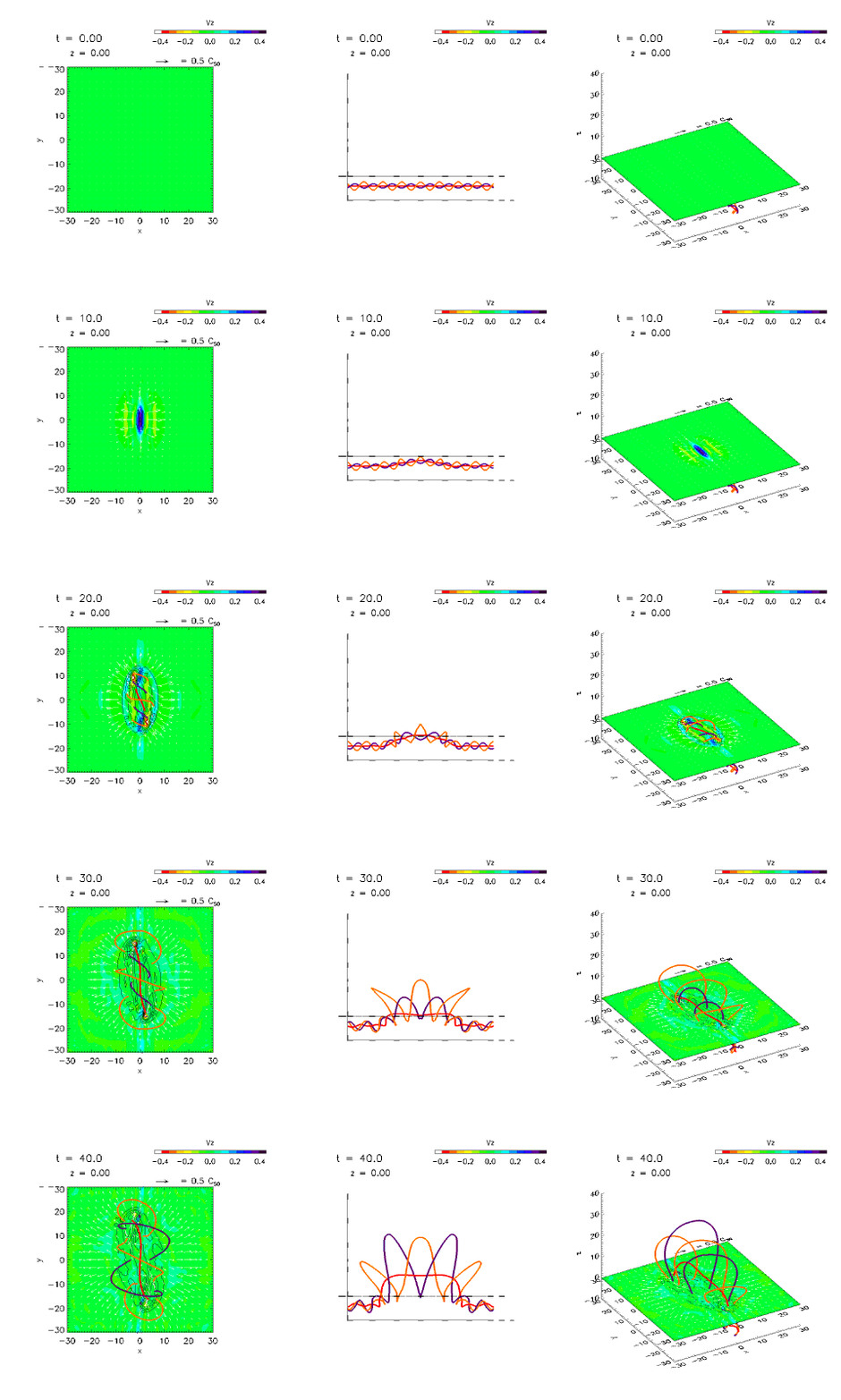
We present results on the emergence of a magnetic flux tube into the solar atmosphere, which are obtained by 3-dimensional MHD numerical simulation. The simulation shows that emerging field lines are classified into two groups according to their evolutionary character: expanding field lines and undulating field lines. Field lines that emerge with a large aspect ratio (the ratio of their height to their footpoint distance) simply continue to expand into the outer atmosphere, while field lines emerging with a small aspect ratio show an undulating behavior in the lower atmosphere without making a simple expansion. Those undulating field lines subsequently either expand into the outer atmosphere or sink toward the photosphere; in the latter case a dip structure develops in the middle of field lines. For the field lines that compose a twisted magnetic flux tube, the outer field lines are expanding field lines and the inner field lines are undulating field lines.
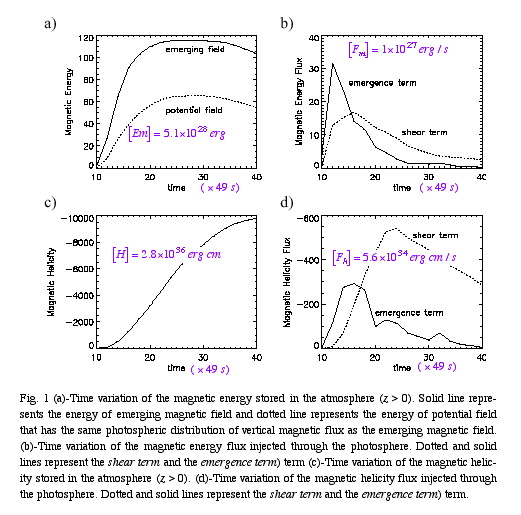
We also study the process of injecting the magnetic energy and magnetic helicity into the atmosphere while the emergence proceeds. Those injections are carried on by means of shearing and emerging motions at the base of the atmosphere. It is found that the emerging motion plays a dominant role in injecting energy and helicity at the early phase of emergence and later that role is played by the shearing motion. The emergence starts with a simple dipole structure formed in the photosphere, which is subsequently deformed and fragmented, leading to a quadrapole structure.
Magara, T. & Longcope, D. W. 2003 ApJ, 586, 630