Outflow and Dark Bands at Active Region Core Boundaries

Observations from Hinode’s EIS instrument described in “NONTHERMAL VELOCITIES IN SOLAR ACTIVE REGIONS OBSERVED WITH THE EXTREME-ULTRAVIOLET IMAGING SPECTROMETER ON HINODE” Doschek et al. 2007 show NOAA Active Region (AR) 10926 on 2006 December 2 beginning at 14:06 UT . At left is their figure 1. They reported that largest nonthermal velocities and blue shifted Doppler velocities where not found in the most intense regions, but were concentrated in the less intense regions directly adjacent to coronal loops.
Note that the increased line width (top right) and Doppler velocity (bottom left) highlight the edge of the arcade like active region core.
Outflow at the edges of Active Regions with EIS
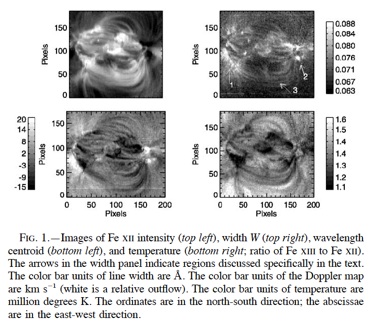
Doschek et al. 2007 figure1

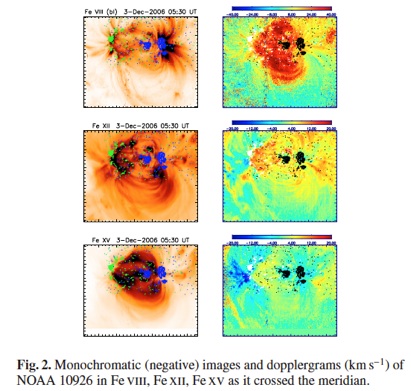
Del Zanna 2008 (“Flows in active region loops observed by Hinode EIS”) investigated
NOAA Active Region (AR) 10926 on 2006 December 2 and 3. Part of figure 2 from this study shows that the blue shifted velocities are found at the edges of the active region core.
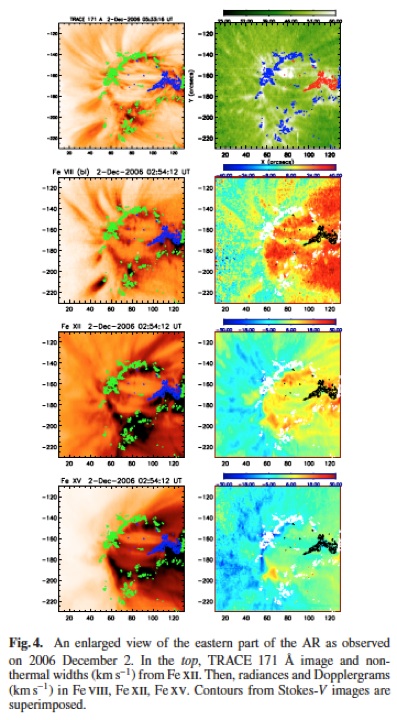
Figure 4 from Del Zanna 2008 study shows that the blue shifted velocities are found at sharp boundaries between the active region core and outer (cooler) periphery loops. From the conclusions: “It is also clear, for the first time, that blueshifts are located in boundary sharp regions and that shifts are higher in higher-temperature coronal lines. The strongest blueshifts are in low-density regions, which explains why they are so difficult to observe. The blue-shifted regions have large non-thermal widths in coronal lines, larger near the base of the corona.”
These boundary areas are over mono-polar regions
Del Zanna 2008 part of figure 2
Del Zanna 2008 figure 4
Outflow at the edges of Active Regions with CDS
Background and Introduction
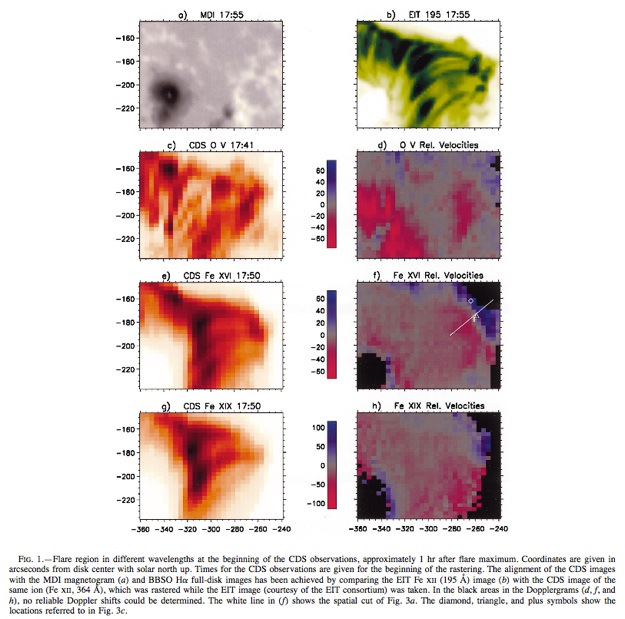
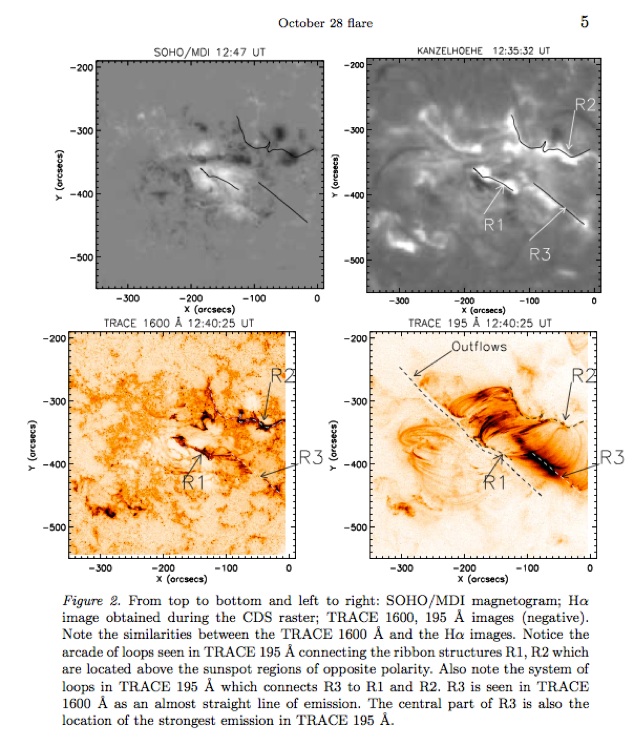
Earlier studies using the Coronal Diagnostic Spectrometer (CDS) on SOHO demonstrated similar blue shifted Doppler velocity locations. These studies attribute cromospheric evaporation to the blue shifts, but they are only shown here to draw attention to the similarity of outflow at the edge of arcade like active region cores.
Czaykowska et al. 1999 found outflows (blue shifted Doppler velocities) outside the bright intensity areas of the arcade like active region core.
Del Zanna et al. 2006 also found outflows (blue shifted Doppler velocities) outside the bright intensity areas of the arcade like active region core.


Outflow at the edges of Active Regions with EIS:
Connection to Solar Wind?
2008 Doschek et al. “FLOWS AND NONTHERMAL VELOCITIES IN SOLAR ACTIVE REGIONS OBSERVED WITH THE EUV IMAGING SPECTROMETER ON HINODE: A TRACER OF ACTIVE REGION SOURCES OF HELIOSPHERIC MAGNETIC FIELDS?
This study suggests that these outflows may be along open magnetic field lines and extend in to the heliosphere, contributing to the solar wind. This is figure 4 of AR 10978 on Dec 11 2007.
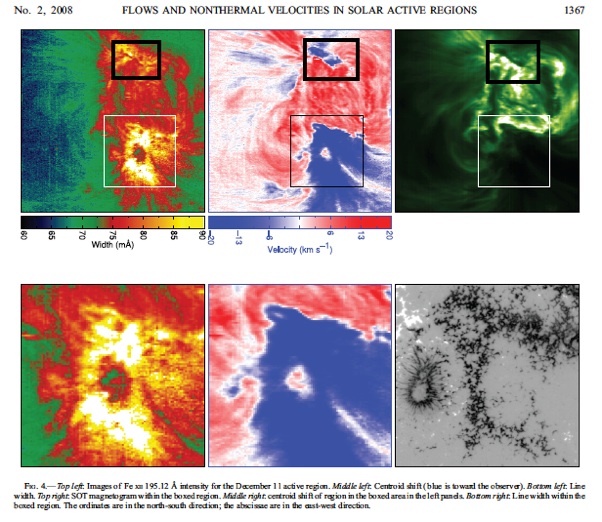
Note that the images in the figures must have been rotated 90 deg. CW for convenience. I’ve added black boxes to draw attention to the dark band region region that is studied in Scott et al. 2012.
The main point I want to draw attention to here (in above) is that there are large regions of low intensity, large line widths and outflows and there are narrow regions of low intensity, large line widths and outflows.

2008 Harra et al. “OUTFLOWS AT THE EDGES OF ACTIVE REGIONS: CONTRIBUTION TO SOLAR WIND FORMATION?”
This study finds steady outflows at the edge of an AR on 2007 February 20 at 23:45. using XRT and EIS. Outflows of 20-50 km/s and estimated flows of >100km/s are reported. These flows are suggested to contribute to the slow solar wind. These flows are found in low intensity regions.

2011 Brooks and Warren, “ESTABLISHING A CONNECTION BETWEEN ACTIVE REGION OUTFLOWS AND THE SOLAR WIND: ABUNDANCE MEASUREMENTS WITH EIS/HINODE”
This study finds strong outflows at the edges of and active region (up to 50km/s and line asymmetries up to 200km/s). They study AR 10978 for five days. They measure Si/S ratios in the EIS data and few days later in the Advanced Composition Explorer/Solar Wind Ion Composition Spectrometer data. They find a similar ratio which suggests the connection between active region out flow and the solar wind.
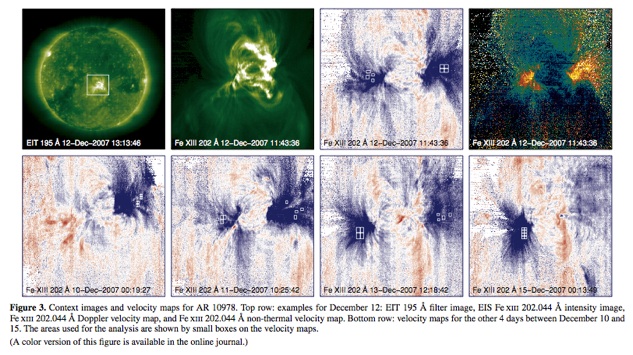
Brooks and Warren 2011 figure 3
Doschek et al. 2008 figure 4
What drives the outflow at the edges of Active Regions?
Reconnection?
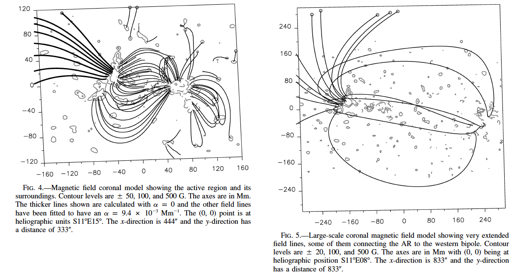
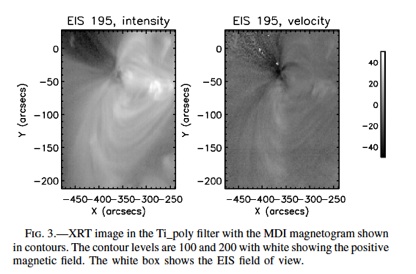
The outflow is formed between the arcade like core loops and outer larger scale loops or possibly open field lines
2009 Baker et al. “MAGNETIC RECONNECTION ALONG QUASI-SEPARATRIX LAYERS AS A DRIVER OF UBIQUITOUS ACTIVE REGION OUTFLOWS”
This paper finds the largest outflows are coincident with quasi-separatrix layers (QSLs)
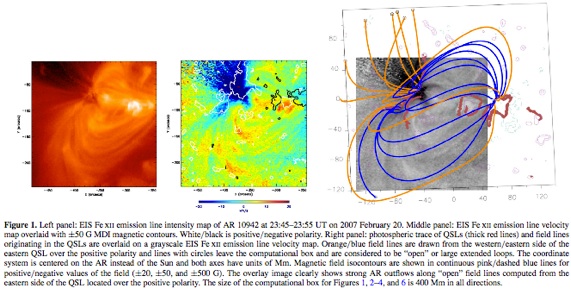
The quasi-separatrix layers (QSLs) are found in regions of low intensity and highly blue shifted Doppler velocities.


Active Region Expansion?

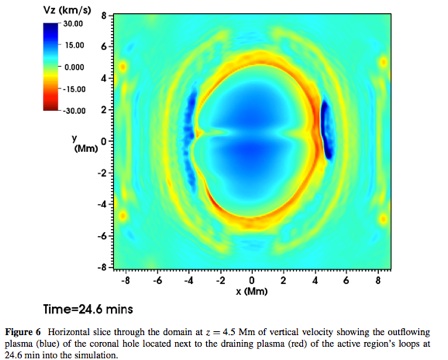
2010 Murray et al. “Outflows at the Edges of an Active Region in a Coronal Hole: A Signature of Active Region Expansion?”
This study shows a simulation of the emergence of a flux tube into a coronal hole. Outflows at the edge of the emerging AR with draining flows on the inner active regions loops.
2010 Harra et al. “Response of the Solar Atmosphere to the Emergence of ‘Serpentine’ Magnetic Field”
From the Abstract:
“The most distinctive feature in the Doppler velocity is a strong ring of coronal outflows around the edge of the emerging flux region on the eastern side which is either due to re- connection or compression of the structure. This feature lasts for many hours and is seen in many wavelengths.”
The “ring” can also be seen in increased line widths’
Magnetic Flux Emergence?

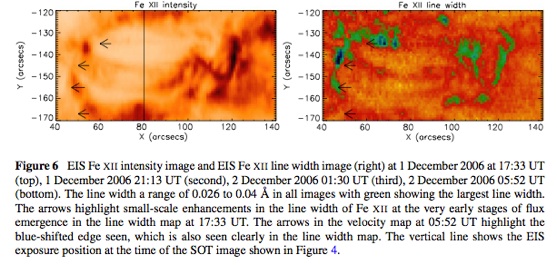
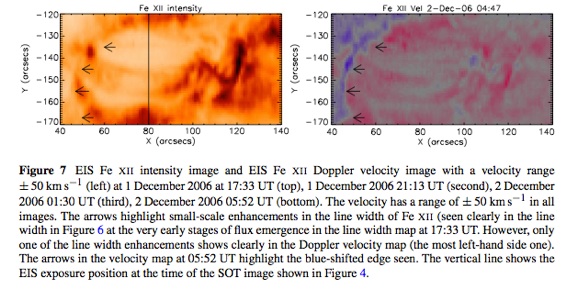
Harra et al. 2010 parts of figures 6 and 7
2011 Harra et al. “The Creation of Outflowing Plasma in the Corona at Emerging Flux Regions: Comparing Observations and Simulations”
This investigation simulates an emerging bi-pole into a pre-existing magnetic field (below left). Outflows are found at the boundaries of the emerging field (below right).

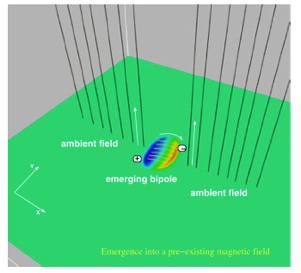
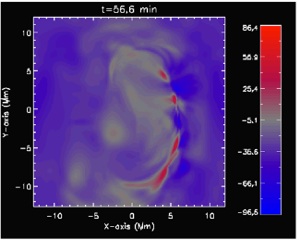
Harra et al. 2011 parts of figures 9 and 11