Implications

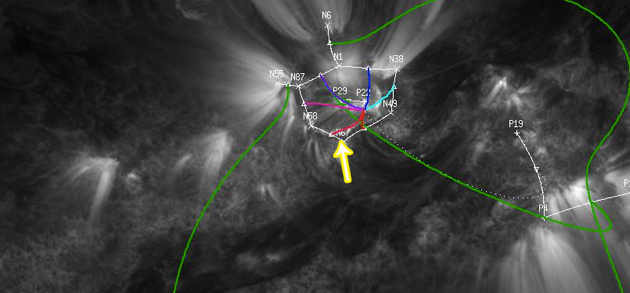
The dark bands and outflows are found at the outer (leading) edge of H-alpha and EUV ribbons. A magnetic field extrapolation shows that just outside the lower ribbon is a narrow dark band region (yellow arrow) that lays over the magnetic spines (white lines) or null lines that connect the nulls of like sign. There are other observations that show magnetic spines close to flare ribbons. Here it is suggested that these spines/separatricies are sometimes visible as narrow dark regions. The connectivity on either side of the narrow dark band (near the yellow arrow) can be seen from the brightened closed loops. One side (lower) is comprised of loops with the older (original) connectivity and the other side is comprised of loops forming the ribbons and connected to the emerged (new) flux. Sandwiched between these two different connectivities there is a separator which magnetic field lines must cross in order to change connectivity. This is where reconnection may occur.
Ribbons and Spines
Flares Ribbons and Spines and Quasi-Separatrix Layers (QSLs)
The locations of flare ribbons and spines, separatricies or QSLs are thought to be very close. Flare ribbons are observed to expand and separate. This separation has been used in efforts to quantify the reconnection rate. A recent article poses an interesting question “Where do flare ribbons stop?” (Chen et al. 2011). Their conjecture is essentially the same as the CSHKP model with outer separatricies or QSLs that separate the inner field that participates in the flare and the outer field with a different connectivity (open or closed). They propose that flare ribbons stop when they reach these outer separatricies or QSLs (see fig 1 Chen et al. 2011 below)

Something like the conjecture that Chen et al. 2011 make, may help explain the observations from the famous Bastille day flare of 2000 below. A narrow dark band separating the faint arcade like AR core and the outer periphery loops can be seen before the flare (greyscale below). The dark band is present during the flare (arrow in green left below) and it is this dark band that the footpoints of post flare arcade loops (EUV ribbons) eventually expand to (green left below).


Before flare
During flare
After flare

Brooks and Warren 2011 figure 3
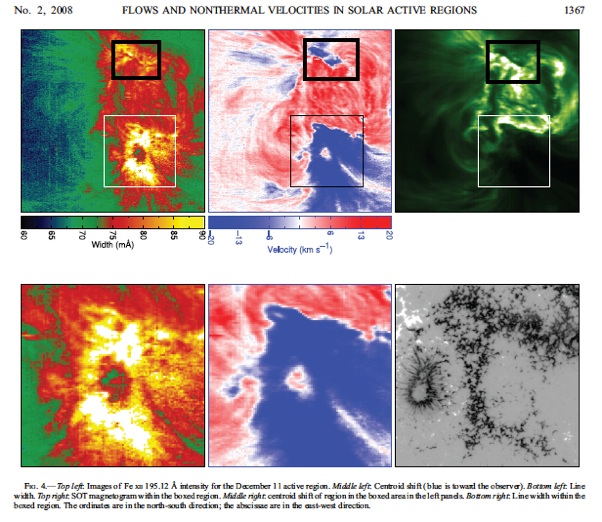
Doschek et al. 2008 figure 4 rotated
Solar wind and Dark bands
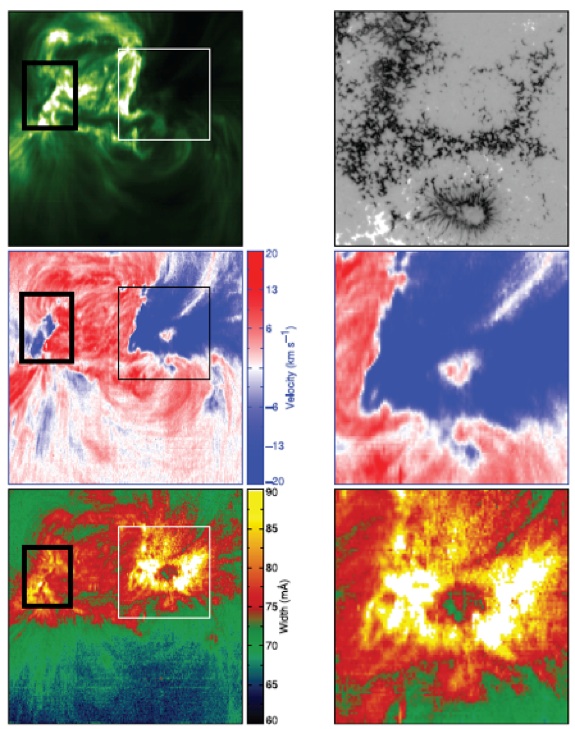
The figures below show AR 10978. Large regions of outflow in low intensity areas are seen on the right of the AR (Doschek et al. 2008 figure 4). The same signature of outflow and increased non-thermal broadening in a low intensity area can be seen in a dark band region on the left of the AR core (white arrows directly below). Below, Figure 3 from Brooks and Warren 2010 show that this narrow band, on the left of the AR, develops over six days into a larger region of outflow that contributes to the solar wind. This indicates that this boundary region is important to the solar wind and the investigation of the dark band region may aid in understanding how these outflows are produced and thus, how part of the solar wind is formed.

Scott et al. 2012 in preparation