I. In the space next to each statement, write either "T" for TRUE, or "F" for FALSE. (1 pt.
ea.)
F: 1. The altitude of the Pole Star (or the North Star, or Polaris) changes with the seasons.
T: 2. Which stars are visible varies over a year.
T: 3. Because the Earth orbits the Sun, the Moon requires more than a complete rotation to
complete a cycle of phases.
F: 4. The geocentric view is the correct one.
F: 5. The force of gravity does not act on orbiting astronauts, because they're so
far from Earth.
T: 6. To you, the altitude of the celestial pole is your latitude above the terrestrial
equator.
F: 7. The moon cannot be seen during the day time.
T: 8. Even though the Moon is very far from the Earth, gravity acts on it, as seen by its
circular orbit around the Earth.
II. For each question below, provide a brief (1-5 words) answer. (3 pt. ea.)
1. Neglecting atmospheric effects, where on Earth can the Sun be seen for six months,
starting from the autumnal equinox?
Within Antarctic Circle, or South Pole
2. Name one geocentric astronomer.
Ptolemy, any Greek but Aristarchus, Brahe
3. Name one heliocentric astronomer.
Kepler, Galileo, Newton, Aristarchus
4. What is your terrestrial latitude if the celestial equator is in your zenith?
at the equator, or 0o
5. What is at one focus of a planet's orbit? (give one of two possible answers)
the Sun, or nothing
III. Match the term below with the proper definition from the choices given -- and there are
too many choices. (2 pt. ea.)
1. ecliptic -- f.
2. eclipse -- e.
3. epicycle -- a.
4. ellipse -- d.
5. equinox -- g.
6. eccentricity -- b.
a. an orbit on an orbit, invoked by geocentrists to explain retrograde motion
b. describes how elongated an ellipse is
c. thought to be "perfect form" by Greeks
d. a conic section that describes planets' orbits well
e. when one celestial body enters the shadow of another
f. the Sun's path across the celestial sphere, or the plane of the Earth's orbit around the Sun
g. when the Sun rises along the terrestrial equator
h. dividing line between hemispheres
IV. Multiple choice - circle the correct answer from the choices provided.
1. Why can't venus be seen at midnight? (2 pt.)
a) its epicycle stays near the Sun
b) its orbit is too close to the Sun
- ANSWER
c) we're too far north
d) both a) and b)
e) none of the above
2. Why is retrograde motion of planets across the Earth's night sky observed? (2 pt.)
a) the other planets orbit around epicycles, which orbit around deferents
b) the other planets orbit at different speeds than the Earth - ANSWER
c) both a) and c)
d) none of the above
3. According to Newton's Third Law ("for every force, there is an equal and oppositely directed force"), what is the "equal and opposite" force to that holding you down in your seat? (2 pt.)
a) the gravitational pull you exert on the Earth- ANSWER
b) the centrifugal force due to the Earth's rotation
c) the force of the seat beneath you, pushing up on you
d) none of the above
4. Which astronomer discovered that ellipses best represent planets orbits? (2 pt.)
a) Newton
b) Ptolemy
c) Galileo
d) Kepler- ANSWER
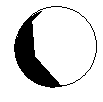
5. What phase is the Moon shown here? (Dark part is filled in.) (2 pt.)
a) waning crescent
b) waxing crescent
c) waning gibbous
d) waxing gibbous- ANSWER
6. Which is the most eccentric? (2 pt.)
 - ANSWER:c)
7. When should you expect a "spring" (higher than usual) tide? (4 pt.)
a) when there's a crescent moon in the east at dawn
b) when there's a crescent moon in the west at sunset
c) when there's a new moon overhead at midnight
d) when there's a full moon overhead at midnight- ANSWER
8. At noon on the Northern hemisphere's longest day of the year, the Sun is directly overhead... (circle all that apply -- 4 pt.)
a) depending on your latitude.- ANSWER
b) depending on your longitude.
c) of anyone in the northern hemisphere.
d) nowhere in the continental United States.
- ANSWER
e) in the Arctic Circle
9. You know a force is acting on an object if it... (circle all that apply -- 4 pt.)
a) starts moving or speeds up- ANSWER
b) slows down or stops moving- ANSWER
c) moves with constant, nonzero velocity
d) changes direction- ANSWER
10. Which discoveries of Galileo's bolstered the heliocentric view? (circle all that apply -- 6 pt.)
a) on Earth, objects fall at same speed,
regardless of mass
b) four moons orbit Jupiter- ANSWER
c) the Milky Way is composed of stars
d) the Moon has terrain similar to the Earth's
- ANSWER
e) Venus goes through phases- ANSWER
V. Problems.
1. Sketch an ellipse to represent a planet's orbital path. Label foci and the semimajor axis,
and put the Sun at an appropriate point. Finally, put the planet at the slowest point in
its orbit. (12 pt.)
2. Suppose on three different days (over a few weeks), you see the Moon directly overhead -- once at sunset, once at sunrise, once at midnight.
a) Fill in the dark part of the Moon as you'd see it on each occasion. (6 pt.) (TEXT in parens. tells which part should be dark.)
i) sunset 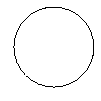 - ANSWER: left side dark
ii) sunrise
- ANSWER: right side dark
iii) midnight
b) For each case above give the Moon's phase. (6 pt.)
i) sunset: 1st qtr.(2 pt.) or waxing gibb/cresc. (1 pt.)
ii) sunrise: 3rd qtr.(2 pt.) or waning gibb/cresc. (1 pt.)
iii) midnight: full (2 pt.)
3. i) Who's law states that the square of a planet's orbital period equals the cube of its
semimajor axis? KEPLER's (2 pt.)
ii) Suppose there were a planet between Mars & Jupiter, with a semimajor axis of 2 AU. What
would its period be? You might use one of these approximations:
(2)1/2=1.4; (2)1/3=1.3; (4)1/2=2; (4)1/3=1.6; (8)1/2=2.8;
(8)1/3=2. Show your work. (4 pt.)
ANSWER: (8)1/2=2.8
4. You and your friend are training for the Bridger Ridge Run this August, and want to know if Mount Blackmore is too long of a run from your houses. You decide to use parallax to determine the distance to the peak (P) from the middle of town (M) between your house (Y) and your friend's house (F), without leaving your houses.
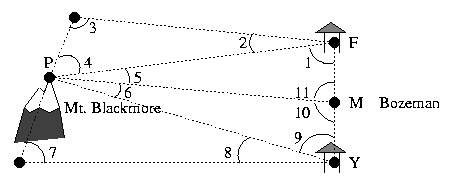
i) Which two angles must you measure, 1,2,3,4,5,6,7,8,9,10, or 11? ANSWER: 1 and 9 (3 pt.)
ii) What distance would you already have to know? (2 pt.)
a) from Y to F - ANSWER
b) from Y to M
c) from M to F
d) none of the above