I. In the space next to each statement, write either "T" for TRUE, or "F" for FALSE. (1 pt.
ea.)
T: 1. One piece of evidence that a large asteroid impact killed off the dinosaurs is a layer of "space dust" in the Earth's geological record.
F: 2. When viewed from the North Celestial Pole,
most objects in the solar sytem revolve around the Sun
in a clockwise direction. (counterclockwise)
F: 3. As the solar nebula contracted to form the solar system,
its rotation rate decreased, due to conservation of angular momentum. (rotation rate increased)
F: 4. We see the Moon because it emits radiation. (reflects; its emission is in IR, which isn't visible)
T: 5. The wavelength of an atom's spectral line
depends only on the difference between the emitting/
absorbing electon's energy levels before & after
the transition, not on temperature.
T: 6. Particles in higher temperature gases move
with higher speeds, making higher energy transitions
more probable -- so the wavelength of spectral
lines observed depends on temperature of the emitting atoms.
(keywords are MORE PROBABLE and OBSERVED)
F: 7. The Sun has been burning for about 5 million years, and will burn for 5 million more.
(replace million by BILLION to get answer I sought)
F: 8. The solar corona is cooler than the next
atmospheric layer closer to the Sun. (HOTTER)
T: 9. None of the planets with rings possess
large moons within the tidal stability limit.
(see Sec. 11.4 in text)
F: 10. A meteor is a meteorite that
fell to the earth without completely burning up.
(answers are reversed)
II. For each question below, provide a brief (1-5 words) answer.
1. List three properties shared by the Jovian planets.
(3 pt. ea.)
larger, farther from Sun, colder, many moons each, have rings, most have internal heat sources, contain H & He, gaseous = no solid surface
2. List three properties shared by the terrestrial planets.
(3 pt. ea.)
smaller, nearer to Sun, warmer, few/no moons, no rings, heated by Sun, have no volatiles (H or He), solid surface, rocky
3. The text supports which theory of our (the Earth's) Moon's origin?
(2 pt.)
GIANT IMPACT
4. Name the highest and lowest energy
spectral ranges of EM (electromagnetic) radiation. (4 pt.)
highest: GAMMA
lowest: RADIO
5. Where is most of the mass in an atom located? (2 pt.)
NUCLEUS
6. Name one way in which heat flows, and give an example.
(4 pt.)
CONDUCTION, RADIATION, OR CONVECTION -- too many
examples to list
III. Matching.
1. Match each property from the choices given at right to a planet at left -- each choice may be used only once. (5 pt.)
|
i) Mercury: c) ii) Pluto: e) iii) Uranus: b) iv) Venus: a) v) Mars: d) |
a. hot and cloudy
b. rotates "on its side" compared with other planets c. has no moon d. has icy polar caps e. orbit is inclined 17o to ecliptic; has largest moon, relative to planet size |
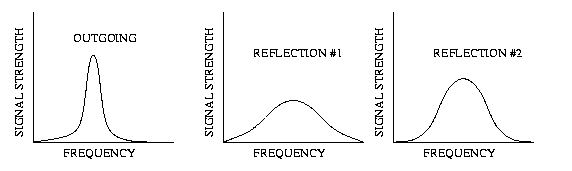
2. Suppose researches send out Doppler radar signals to two nearby planets, and receive the reflections plotted below (1 pt.):
Which planet is rotating faster, #1 or #2? #1 - reflection is WIDER
A)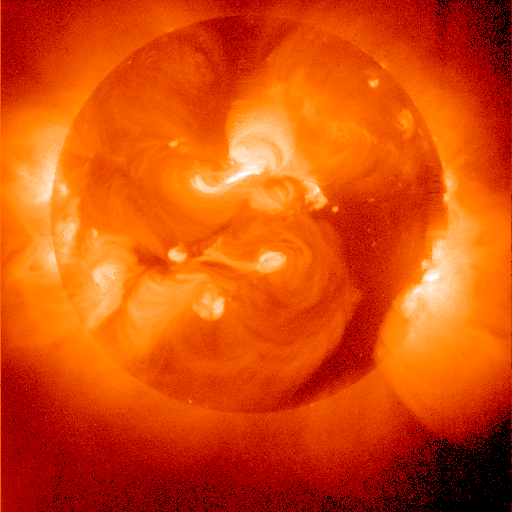 B)
B)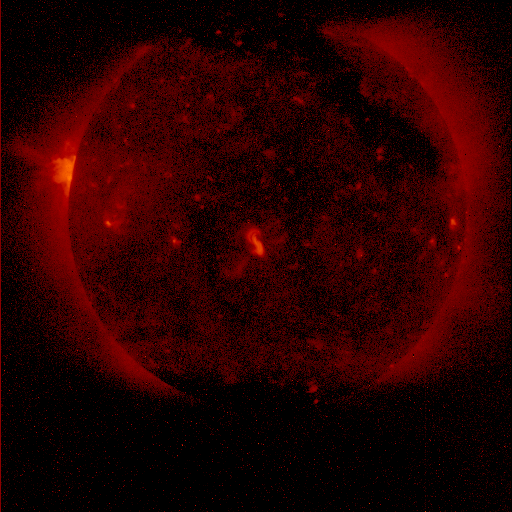
3. For each question (below) about the two X-ray images of the Sun (above), write in the appropriate answer, A or B. (4 pt.)
i) Which image has more active regions? A
ii) You'd see more sunspots in a visible light
version of which image? A
ii) The Sun's magnetic field is smoother and more orderly in which image? B
iii) Which image was taken closest to solar maximum? A
IV. Multiple choice - circle the correct answer from the choices provided.
1. Which of the following is the highest energy spectral range? (2 pt.)
a) infrared (IR)
b) visible
c) radio
d) X-ray - ANSWER
2. Which of the following is the lowest energy spectral range? (2 pt.)
a) infrared
b) visible
c) radio - ANSWER
d) X-ray
3. From the Sun's center outward, (2 pt.) the correct ordering of layers is
a) core, convection zone, corona, photosphere
b) core, chromosphere, convection zone, corona
c) core, corona, photosphere, convection zone
d) core, convection zone, photosphere, corona - ANSWER
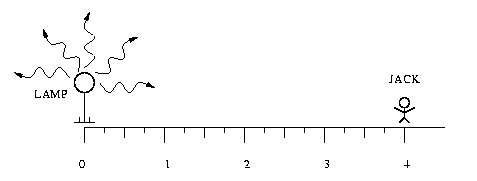
4. In the figure above, a lamp is at the point labelled zero, and Jack is 4 units away. To see the lamp four times larger than Jack does, how far from the lamp should one be? (2 pt.)
a) 1 unit, or four times as close - ANSWER
b) 2 units, or two times as close
c) (2)1/2units, or ~2.8 times as close
d) 8 units, or two times as far
5. Refer to the same figure as in the previous question. To see the lamp four times brighter than Jack does, how far from the lamp should one be? (2 pt.)
a) 1 unit, or four times as close
b) 2 units, or two times as close - ANSWER
c) (2)1/2 units, or ~2.8 times as close
d) 8 units, or two times as far
6. The amount of a Doppler shift is given by

 =
(v/c).
One approaching star emits a spectral line that's Doppler
shifted 50 nm from the unshifted line.
A second approaching star exhibits a Doppler shift of 100 nm.
How do the two stars' velocities compare? (2 pt.)
=
(v/c).
One approaching star emits a spectral line that's Doppler
shifted 50 nm from the unshifted line.
A second approaching star exhibits a Doppler shift of 100 nm.
How do the two stars' velocities compare? (2 pt.)
c) the first is approaching at 1/4 as fast as the second
a) the first is approaching half as fast as the second - ANSWER
b) the first is approaching twice as fast as the second
d) the first is approaching 4 times as fast as the second
7. Suppose scientists dating meteorites find different ratios of "parent" & "daughter" isotopes in several samples. Circle the ratio corresponding to the oldest rock. (2 pt.)
a) mostly parent
b) half parent, half daughter
c) mostly daughter - ANSWER
d) cannot tell from this information
8. The energy in a given amount of EM radiation depends upon (2 pt.)
a) the number of photons
b) the photons' wavelengths
c) both a) and b) - ANSWER
d) none of the above
9. For each group of choices below, circle the term that applies to red shifted radiation. (5 pt.)
i) emitted by an object (approaching/receding from - ANSWER) viewer
ii) frequency compared to unshifted radiation is (lower - ANSWER/higher)
iii) wavelength of radiation is (longer - ANSWER/shorter) than unshifted
iv) time between crests' arrivals is (shorter/longer - ANSWER)
v) energy of radiation is (higher/lower - ANSWER) than unshifted radiation
10. The "solar nebula" hypothesis of our solar system's formation explains (circle all that apply; 6 pt.)
a) the composition of the planets - ANSWER
b) the number of planets and moons
c) the locations of the planets
d) the direction of rotation & orbit of most
objects in the solar system - ANSWER
e) the common ages of most objects in the solar system - ANSWER
f) all of the above
V. Problems.
1. Sketch an eccentric elliXpse to represent the path
of a comet that completes one orbit through our solar system.
(Don't worry about scale.) Put the Sun at an appropriate point.
Draw the comet's nucleus at two different places:
perihelion, and a point midway between perihelion and aphelion.
At both points, indicate which direction you want the comet to travel,
and sketch and label both the ion and dust tails.
(6 pt.)
WILL PUT IN SOON.
2. Suppose you observe light emitted from a distant
binary system (a pair of stars that orbit each other;
pictured below) on several nights.
Because the smaller star's mass is less, the smaller star
appears to orbit, while the larger star essentially stays put.
Each time you observe the system, the small star is
at one of the points indicated, A,B,C,D, or E. (6 pt.)
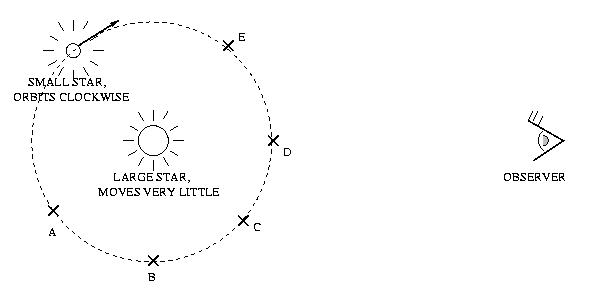
i) at which point (A,B,C,D,E) will the Doppler shift be the most red? B
ii) at which point will the shift be small and blue? E
iii) at which point will you see no shift? D
3. Thermal Radiation:
i) On the plot below, sketch and label two blackbody curves,
one for the Sun (hot), one for Jupiter (cold). (2 pt.)
ii) Label the axes, including the direction of increase.
(2 pt.)
iii) Which law determines how tall each peak is?
(1 pt.) STEFAN-BOLTZMANN LAW
iv) Which law determines the wavelength of the peak emission?
(1 pt.)WIEN'S LAW
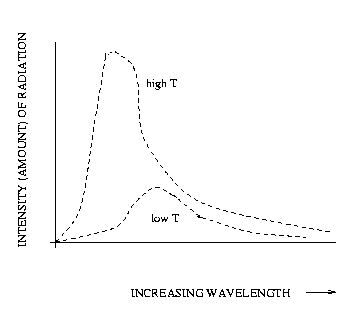
SUN is HIGH TEMP., JUPITER is LOW TEMP. High temp. peak must be taller, and at shorter wavelength than low temp. peak.
4. Three observers see spectra (using prisms)
along three different lines of sight,
as pictured schematically below. (5 pt.)
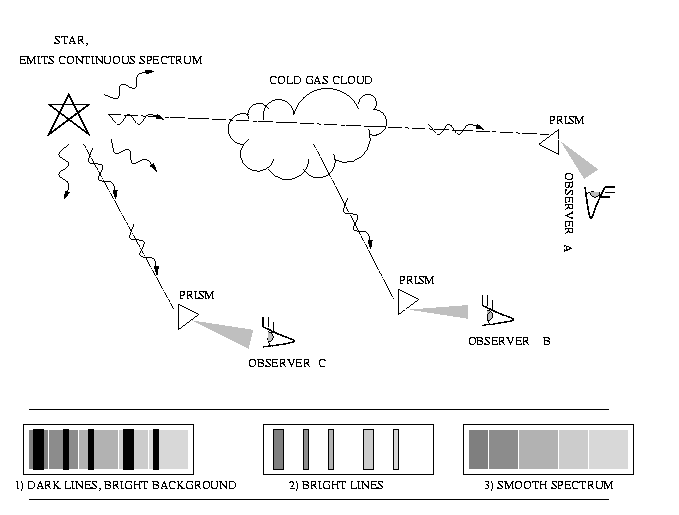
Which observer sees which spectrum?
A) 1; B) 2; C) 3
Spectrum #1 is an ABSORPTION spectrum.
Spectrum #2 is an EMISSION spectrum.