I. In the space next to each statement, write either "T" for TRUE, or "F" for FALSE. (1 pt. ea.)
_____ 1. At noon on the northern hemisphere's longest day
of the year, the Sun does not stand directly
overhead in the continental U.S.
_____ 2. Elements with more protons than iron
were formed in supernovae.
_____ 3. Just before a lunar eclipse, the moon is new.
_____ 4. A closed universe will expand forever.
_____ 5. Kepler believed planets' orbits were circular, since
he thought circles to be perfect forms.
_____ 6. As you move away from the equator,
the size of the circumpolar region you see increases.
_____ 7. The Sun's energy comes from fusing
4He into 1H.
_____ 8. In the northern hemisphere, the Sun rises
south of east in the winter.
_____ 9. A K-type star excites higher energy spectral
transitions than an A-type star.
_____ 10. The cosmic microwave background is hotter
now than it was in the past.
_____ 11. Red light scatters more easily than blue light.
_____ 12. The wavelength of a spectral line
depends on temperature.
_____ 13. The Sun lies directly over the Tropic of
Capricorn on the northern hemisphere's winter soltsice.
_____ 14. Shorter wavelength spectral lines are excited
in higher temperature stars.
_____ 15. Comets' ion tails point away from the Sun,
while their dust tails trail behind them along their orbital path.
II. For each question below, provide a brief
(1-5 words) answer. (3 pt. ea.)
1. When the Moon rises at noon, what is its phase?
2. At which two phases of the Moon should you expect higher tides
than usual?
3. To determine that the Milky Way's core houses a
supermassive black hole, astronomers tracked stars near
the core as they moved across our sky.
What do we call these stars' apparent changes in position?
4. a) Theoretically, what is the largest mass a white dwarf
can have before it collapses into a neutron star?
(This mass is known as Chandrasekhar's limit.)
b) Once a white dwarf has collapsed into a neutron star,
what keeps it from collapsing further?
5.b) How many years does it take the Sun's field to both reverse itself and return to its original configuration?
b) How many years does it take the Sun's field to both reverse itself and return to its original configuration?
III. Matching: Next to each distance indicator below,
write the letter corresponding to the GREATEST
distance at which it is useful. Obviously, you can use
each maximum range more than once. (5 pt.)
|
Distance Indicator variable stars ______ radar ______ parallax ______ Hubble shifts ______ main seq. fitting ______ |
useful range a) within solar system b) within/near Milky Way c) other spiral galaxies |
IV. Multiple choice - circle the correct answer from the
choices provided.
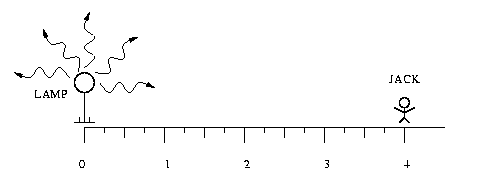
1. In the figure above, a lamp is at the point labelled zero, and Jack is 4 units away. To see the lamp two times larger than Jack does, how far from the lamp should one be? (2 pt.)
a) 1 unit, or four times as close
b) 2 units, or two times as close
c) (2)1/2units, or ~2.8 times as close
d) 8 units, or two times as far
2. Refer to the same figure as in the previous question. To see the lamp four times dimmer than Jack does, how far from the lamp should one be? (2 pt.)
a) 1 unit, or four times as close
b) 2 units, or two times as close
c) (2)1/2 units, or ~2.8 times as close
d) 8 units, or two times as far
3. Pairs of stars that can be seen to orbit each other on are called (2 pt.)
a) spectroscopic binaries
b) visual doubles
c) optical binaries
d) none of the above
4. Binary systems in which one member of the pair of orbiting stars blocks light from the other are called
a) spectroscopic binaries (2 pt.)
b) visual doubles
c) optical binaries
d) none of the above
5. A solar-mass main sequence star in a binary system can eventually be observed as (2 pt.)
a) a nova
b) a type I supernova
c) a pulsar
d) all of the above
6. By studying blackbody curves from one hot and one cold object, one knows (2 pt.)
a) the peak of emission from the hotter object is taller
b) the emission from the colder object
peaks at shorter wavelengths
c) both a) and b)
d) neither a) nor b)
7. Which of the following astronomers believed the heliocentric hypothesis? (Circle all that apply. 4 pt.)
a) Newton
b) Kepler
c) Copernicus
d) Ptolemy
8. What can be said of stars of spectral class B? (Circle all that apply. 4 pt.)
a) B-class stars are larger than
K-class stars of the same luminosity
b) B-class stars of lower luminosity are smaller than B-class stars of higher luminosity
c) they will burn themselves out more quickly than M-class stars
d) they are hotter than the Sun
e) even though their spectral lines differ from other classes,
their composition is similar to stars of other classes
9. Conservation of angular momentum predicts (Circle all that apply. 4 pt.)
a) most planets & moons in the solar system orbit
counterclockwise when viewed from the North Celestial Pole
b) neutron stars collapse into black holes
c) planetary nebulae should spin slower as they move away
from their parent white dwarfs
d) why the solar nebula should rotate more slowly while
collapsing to form the Sun
e) neutron stars should spin faster than the stars that formed them
10. What properties would enhance an extrasolar planet's chances of being discovered from radial velocity fluctuations? (Circle all that apply. 4 pt.)
a) high mass
b) large diameter
c) close proximity to host star
d) hotter spectral class for host star
V. Problems.
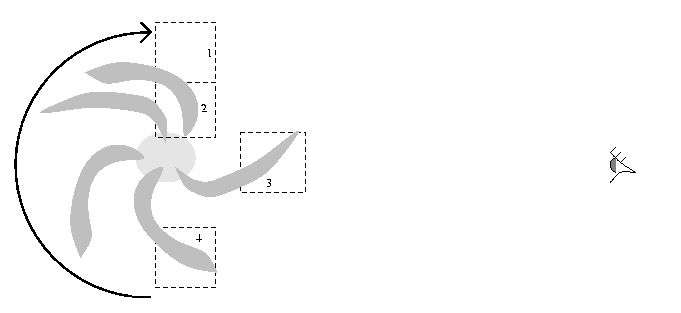
1. The galaxy at left below rotates clockwise from your perspective. The observer at right analyzes light from four different parts of the galaxy, each shown with a box. Answer the questions below the figure by writing in the appropriate number(s) in the blanks. (10 pt.)
a) List the redshifted part(s) of the galaxy, compared to other parts.
_____
b) List the part(s) exhibiting neither red nor blue shifts
compared to other parts. _____
c) Of the parts approaching the viewer, which would Kepler
predict to be orbiting more slowly,
based upon the amount of visible matter? _____
d) Would the observer actually measure this part orbiting
more slowly? Circle one: YES or NO.
e) Provide a short (1-5 word) answer:
What do astronomers believe causes the difference
between Kepler's prediction and what the observer measures?
2. Absolute magnitude is a star's brightness
at a distance of 10 pc from the star.
In the table's third column, state whether
the star is closer or farther than 10 pc. (2 pt.)
|
Apparent Mag. + 5.0 + 3.4 0.0 +11.1 |
Absolute Mag. + 7.0 - 1.4 + 2.1 - 5.6 |
closer/farther |
3. Mindless Regurgitation of Facts:
a) List the planets, in order of increasing distance from Sun. (5 pt.)
5. Three observers see spectra (using prisms)
along three different lines of sight,
as pictured schematically below. (4 pt.)
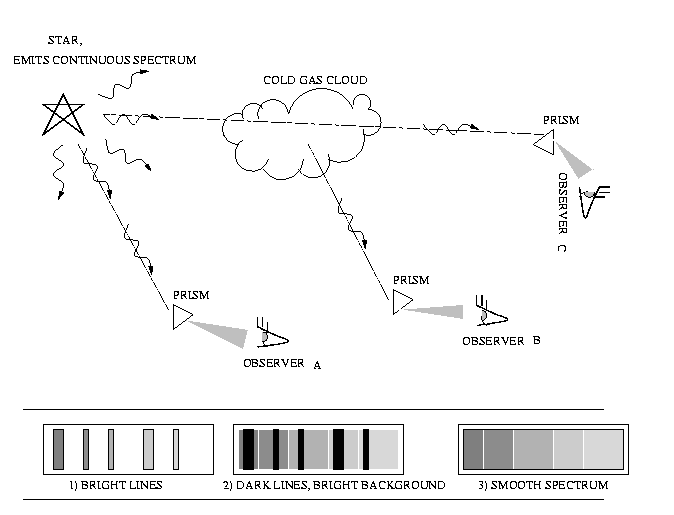
Which observer sees which spectrum?
A) _____; B) _____; C) _____
Spectrum #1 is an ____________ spectrum.
Spectrum #2 is an ____________ spectrum.
6. Hertzprung-Russell (H-R) Diagram:
a) On the balnk plot below, choose appropriate labels for the axes as they could appear on an H-R diagram, and indicate the direction of increase for each, if appropriate. (2 pt.)
b) Name another label you could use for each axis: (2 pt.)
c) On the plot, sketch in where white dwarfs, the giants, and the main sequence fall. (3 pt.)
d) Label the approximate current location of the Sun on the diagram.
(1 pt.)