Lecture 11. B. Atomic Structure
 Everything we touch is composed of ATOMS.
- opposite charges attract: negative ELECTRONS, or e-'s, orbit a NUCLEUS composed of
positve PROTONS, or p+'s, and neutral NEUTRONS, or n's
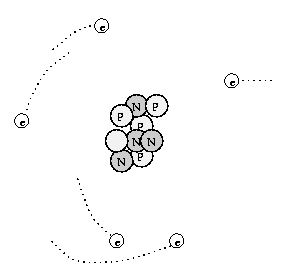
- e-'s orbit in many ways ("electon cloud"), but some picture them as planets orbiting Sun
(electricity is 1/R2 force, just like gravity!)
- atoms are happiest when electrically neutral: same # of e-'s & p+'s
- if # of p+'s exceeds # of e-'s, atom is positively charged -- and will seek e'-s! (more later...)
- "atomic number" Z is defined to be # of protons, always same for a given element
- "atomic mass" A is number of nucleons, the sum of p+'s and n's
- atoms with same # of e-'s and p+'s, but differing #'s of n's are isotopes of same element
Rutherford showed most of atom is empty space -- my fig above is not to scale!
- nucleus is DENSE -- literally 99.95% of mass, in about 10-14m
- electrons' orbits are about 10-10m across
- so if a nucleus were basketball-sized, e-'s would be about 3 km (or 2 miles) away most of
the time