 Electromagnetic (EM) radiation is a propagating wave of oscillating
ELECTRIC (E) and MAGNETIC fields, which moves at the speed of light.
Electromagnetic (EM) radiation is a propagating wave of oscillating
ELECTRIC (E) and MAGNETIC fields, which moves at the speed of light.
Electromagnetic (EM) radiation is a propagating wave of oscillating
ELECTRIC (E) and MAGNETIC fields, which moves at the speed of light.
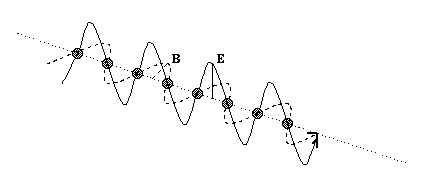
A changing E field produces a B field, and vice versa. Hence, an EM wave is
self-sustaining -- it "bootstraps" along, as in "pulling oneself up by one's boot straps!"
We'll only consider the E field for now, out of simplicity.
Sometimes EM radiation acts like a particle or PHOTON: collides like a billiard ball
Sometimes EM radiation acts like a WAVE: reflects, refracts, etc.
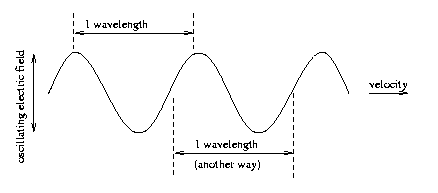
We describe an EM radiation in terms of wavelength,
 , or frequency, f
are related!*
= LOWER f, and
SHORTER = HIGHER f One thing the book does not emphasize enough, I think:
more BUMPS = more ENERGY!
Of the EM waves we see as light, red has a longer wavelength than blue
We should combine all this info. in one place:
|
CATEGORY ____________________ ____________________ ____________________ ____________________ ____________________ ____________________ |
HIGHER ENERGY ____________________ ____________________ ____________________ ____________________ ____________________ ____________________ |
LOWER ENERGY ____________________ ____________________ ____________________ ____________________ ____________________ ____________________ |
The text (fig. 4.5 & table 4.1) lists characteristics of EM radiation
across the spectrum -- wavelengths, frequencies, and temperatures of formation.
You shouldn't
memorize any numbers with each spectral category, BUT YOU SHOULD BE ABLE to place the categories in
the correct ORDER according to energy, wavelength, frequency, or temperature.
If you know the
order in one category, you can move between them if you understand this table above!