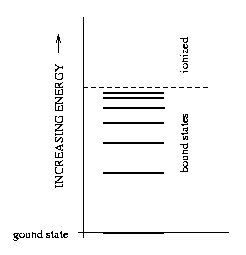
 Electrons can orbit atoms with different amounts of energy -- but only certain
"allowed" energies, called ENERGY LEVELS or ORBITALS. No e-'s can orbit atoms with energies between
allowed levels.
Electrons can orbit atoms with different amounts of energy -- but only certain
"allowed" energies, called ENERGY LEVELS or ORBITALS. No e-'s can orbit atoms with energies between
allowed levels.
Electrons can orbit atoms with different amounts of energy -- but only certain
"allowed" energies, called ENERGY LEVELS or ORBITALS. No e-'s can orbit atoms with energies between
allowed levels.
e-'s can change levels by absorbing or emitting a photon
there are minimum and maximum levels:
according to the principle PAULI EXCLUSION,
orbitals can be full -- meaning an e- cannot move into the full orbital,
even if it has the correct energy
Each element has its characteristic arrangement of energy levels
 's and f's characteristic of these
energies
's and f's characteristic of these
energies