Lecture 13. A. Scientific Questions Asked Influence Observatory Design.
 1. Q: How are celestial objects ALIGNED?
A: Construct geometric observatories -- pretelescopic
2. Q: What do DETAILS of celestial bodies look like?
A: Use
telescope*
to GATHER MORE LIGHT from celestial objects into eye -- thanks, Galileo!
- Galileo saw Lunar terrain, Jupiter's moons, bumps on Saturn -- limit of RESOLUTION
- larger APERTURE (diameter) = more light = RESOLVE more detail
- big glass lenses are too heavy
- largest such REFRACTOR is 40" at Yerkes, outside of Chicago, p.115
- use mirrors to gather light -- REFLECTORS
- can make mirrors much larger but with weight -- e.g., 5m Palomar, p.111
- can make very big mirrors out of many smaller -- e.g., 10m Keck's, p.117
- most amateur astronomers use reflectors
- largest apertures for optical telescopes prob'ly reached -- what's next?
- optimize SEEING with existing equipment
- choose good sights -- high, dry, steady
- reduce temperature fluctuations
- reduce light pollution
- ask different questions, like...
3. Q: What do things look like in invisible wavelengths?
- Spectral region by spectral region, let's look at observing requirements:
- Q: What do COLD or NON-THERMAL emissions look like? A: radio/microwave
- metals act just like mirrors
- long wavelengths (up to km!) requires large aperture to "see" detail
- build large telescopes, e.g. Arecibo, p. 122
- build large arrays of telescopes in one location, e.g. Very Large Array
- group many telescopes across great distances, e.g. VLBI
- water absorbs some wavelengths
- Q: What does WARM STUFF look like? A: infrared
- warm objects (> 150 K) emit thermal radiation in infrared
- water absorbs -- make observations high and dry!
- (done visible already)
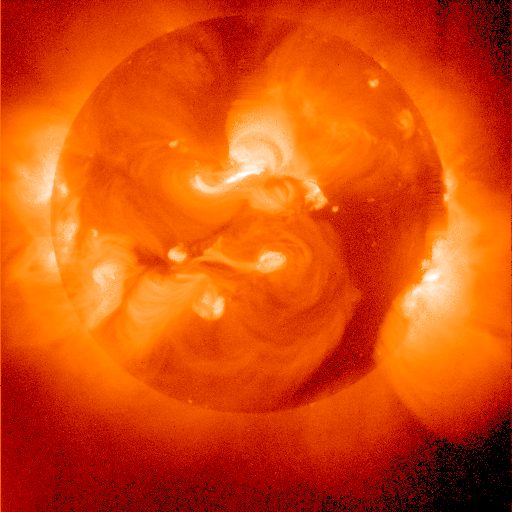
- Q: What does HOT STUFF look like? A: ultraviolet, X-ray, gammma-ray: