Lecture 19. More of The Sun
 A. Class Business --
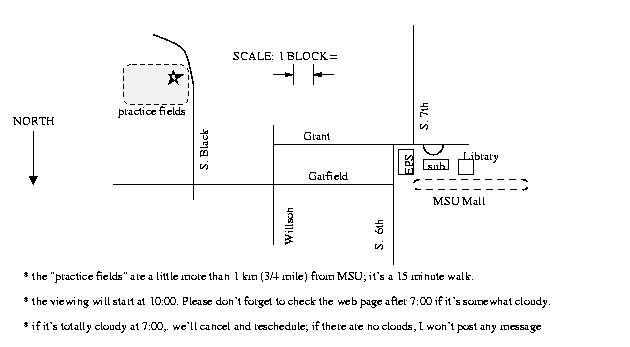
- Jupiter & Saturn Viewing, late tonight --
2:00, Lions Club Fields ...How to notify?
- Exam 1 error: key wrong, semimajor vs. major axis
- Midterm grades -- posted after class; slightly low
- Activities, Quizzes, & Homework #3 solutions posted
- Homework -- due a.m. lecture on Fri. -- questions??
B. Ch. 15: Fusion
I. Strong Force
- Q: Why don't p+'s (protons) in nucleus fly apart?
- (after all, opposite electric charges attract, and likes repel!)
- A: the short-range STRONG force holds them together
(electrical attraction and repulsion are by weak force)
- put nucleons (p+'s and n's [neutrons]) close enough & they attract --
and give off "BINDING ENERGY" if joined
- must be very close: 10-14 meters
- if nucleus is too large across, nucleons at edges feel less pull, and escape = RADIOACTIVITY!
- requires high speed, or high TEMPERATURE, for p+'s to get close enough before their electrical (weak force) causes repulsion
- iron (Z=56) is best at holding nucleons together: not too few nucleons, not too many (too large)
II. Fusion -- P-P CHAIN fuels the Sun
C. Ch. 14 -- The Sun, in detail!
- Three mechanisms of heat flow are...
- CONDUCTION: requires contact;
EXAMPLES (on Earth):________________________________
- RADIATION: involves EM radiation
EXAMPLES:________________________________
- CONVECTION: hot stuff moves to displace cold
EXAMPLES:________________________________
- Layers in the Sun
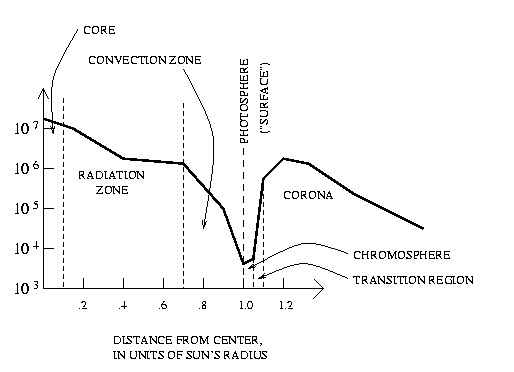
Mechanisms of heat flow in the RADIATION and CONVECTION zones are easy enough...
Q: What is mechanism of heat flow in CORE?
A:_______________________
Q: What is biggest mechanism of heat flow
above PHOTOSPHERE?
A:_______________________
- Q: Why dip in temperature across Sun's surface?
A: Magnetic field connects interior to corona, across surface!
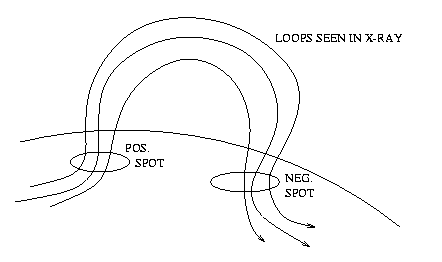
- Heat conducts along magnetic field, not perpendicular to it.
- Sunspots are therefore insulated from rest of photosphere's heat, and appear dark.
- (actually quite bright, just not relative to p-sphere)
- Q: Where does magnetic field come from?
A: We assume some PRIMORDIAL FIELD
started long ago, and is maintained by a DYNAMO
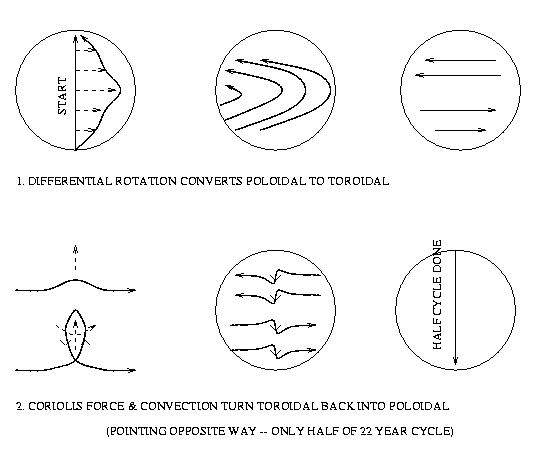
- DIFFERENTIAL ROTATION converts POLOIDAL (pole-to-pole) field into TOROIDAL field (torus or donut-shaped)
- CONVECTION and CORIOLIS FORCE causes
field to rise and twist to restore
POLOIDAL field (but in opposite direction)
- This explains why
leading and following sunspots
differ in polarity in different hemispheres*, and why the leading polarity flips every 11 years.
- The Sun has most sunspots in between
steps 1 & 2 above,
when the large scale field is disorganized.*
III. Flares
- Since convective interior is boiling (turbulent),
it twists up magnetic fields.
- Just like rubber bands and phone cords,
magnetic fields "kink up" when twisted too much
-- this instability causes a SOLAR FLARE!
- We don't understand how the instability works,
or how flares reduce the twist in fields.
But we DO know
twisted fields will erupt!*
- Many flares lift material off of Sun.
Maybe they take twist with them?*
IV. Sun-Earth Connections
- SOLAR WIND carries away heat, radiation, & particles
(mostly p+'s, e-'s, and n's) -- connects us to solar events.
- Flares have many effects on Earth.
- aurorae
- power outages
- satellites damaged
- "radio storms" that hamper communications
- Number of sunspots apparently affects us:
- fewer sunspots in Maunder Min. = "Mini Ice Age"
- best guess: increased solar activity accounts for AT MOST
2/3 of observed global warming --
if so, some must be due to greehouse effect!
V. The Sun -- Links
- good image overview*
-
good Yohkoh images page*
-
more links than you'd ever want*
-
MSU's solar group*
Aside: Temperature and Observed Line Radiation
- The wavelength of emission and absorption spectral lines are fixed by the differences between atomic energy levels...
- So a given spectral line's wavelength is independent of temperature...
- But whether a line is excited in a gas or not DOES depend on temperature:
atoms collisions depend on temperature, and in many cases collisions cause e-'s to change energy levels
