 The celestial sphere is an imaginary sphere of infinite size
surrounding the Earth with the stars embedded in its surface.
The celestial sphere is an imaginary sphere of infinite size
surrounding the Earth with the stars embedded in its surface. 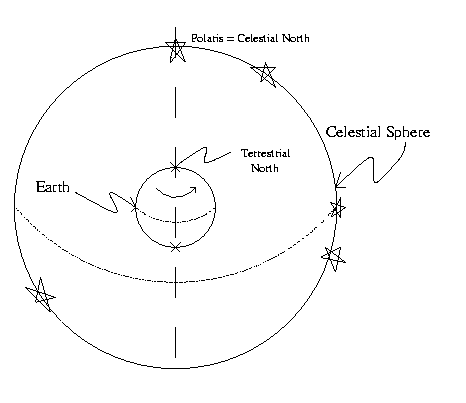 The celestial sphere is an imaginary sphere of infinite size
surrounding the Earth with the stars embedded in its surface.
The celestial sphere is an imaginary sphere of infinite size
surrounding the Earth with the stars embedded in its surface.
The Earth blocks half of this celestial sphere from view at any instant; where the two meet is
your horizon.
But the Earth's rotation causes the stars to rise in the east and set in the west
-- which, as you know, is what the Sun does.
Which stars you see depends on:
i) where you are on the Earth -- your latitude;
ii) the time of night -- which way the Earth is turned;
iii) whether the Sun is up -- though still there, stars are lost in the Sun's light.
Points on the celestial sphere correspond to points on the Earth:
Your zenith is the point on the celestial sphere directly over your head.
The celestial poles are projections of the Earth's north and south
poles onto the celestial sphere.
The celestial equator lies over the terrestrial equator.
The Earth rotates inside the (apparently) fixed sphere, turning about its axis, a
line through the terrestrial poles.
To the ancient Greeks and many others, however, it appeared that the
celestial sphere was turning, not the Earth.
The ecliptic is the apparent path followed by the Sun around the
celestial sphere as the Earth orbits the Sun.
Links:
good graphic;
cool movie;
Terrestrial Celestial Sphere!