Lecture 23. Stellar Astrophysics
Lecture 23. Stellar Astrophysics
 A. Class Business
- We'll discuss Exam 2 this afternoon.
- Reading for Wed.:
- Chapter 18.
- Preface to Ch. 19, Sec. 19.4, 19.5
- Preface to Ch. 20 (see table 20.1), Sec. 20.4
- Viewing Friday, 7/30, 10:00 p.m., Museum of Rockies
- turn in OUT-OF-CLASS ACTIVITY papers next MONDAY, 8/2
B. Apparent vs. Intrinsic Brightness ("AMOUNT" of light)
STARS APPEAR TO DIFFER IN BRIGHTNESS
- LUMINOSITY is intrinsic: a property of object, not observer
- BRIGHTNESS diminishes with distance: 1/R2
- what we see in the sky is APPARENT BRIGHTNESS, varies as:
- luminosity
- distance
- IF every star had identical brightness (STANDARD BULB[CANDLE]),
then apparent brightness would determine distance to each star
-- alas! it ain't so simple!
C. Apparent vs. Absolute Magnitude
Feeling the need to quantify things, physicists define terms:
- absolute brightness: how bright a star appears from an agreed upon
distance away
- magnitude -- a BRIGHTNESS SCALE:
- scale is backwards from what you'd expect:
- silly gradations on scale -- each unit on scale is about 2.5 times as bright/dim
D. Color Indices: know of them, but don't know them...
E. Stellar Spectra ("TYPE" of light)
STARS' SPECTRA ARE DIFFERENT
- Q: Do different stellar spectra imply different stellar compositions?
A: Simply put, NO: they're all basically made of H and He!
- (ASIDE: all elements above H & He are "metals" to astronomers!)
- THE PRIMARY REASON STELLAR SPECTRA DIFFER IS
THAT STARS' TEMPERATURES DIFFER.
Spectral lines' wavelengths are fixed by atoms' energy levels...
but if they're never excited you'll never see them!
And temperature usually determines which get excited.
(cf., Fig. 16.5)
- Differing spectra led to SPECTRAL CLASSES, from HOT to COLD:
O,B,A,F,G,K, & M
- each spectral class differs in temp, and so differs in excited lines
- each class has subclass defined by a numerical suffix,
which also works "backwards:" B9 is cooler than B2
F. Stellar Motions:
- PROPER: seen as movement with repect to other stars
-- "motion in the plane of the sky"
- RADIAL: toward or away from observer, seen as DOPPLER SHIFT
-- "motion along the line of sight"
- ROTATION: spectral lines are WIDER,
since motion of some parts toward us blue shifts lines,
while motion of some parts away red shifts them
-- cf., Activity 5., on the Doppler Effect
G. Binary Stars
- VISUAL BINARIES: orbit each other, visibly separate in sky
- (cf., OPTICAL DOUBLE: stars only apparently close, do not orbit)
- SPECTROSCOPIC BINARY: stars whose spectral lines
show them to orbit each other -- cf., Fig. 17.6
- can get total mass in binary system from Kepler's Third Law:
- in ECLIPSING BINARIES, can get each star's diameter from
LIGHT CURVES during eclipes
H. Patterns 1. MORE MASSIVE stars have HIGHER LUMINOSITIES
- recall HYDROSTATIC EQULIBRIUM (Ch. 15):
PRESSURE/ENERGY out = GRAVITY in
- If a star has more mass, it has stronger gravitational pull.
- To balance this, fusion must produce more energy/pressure
= HIGHER LUMINOSITY
I. Patterns 2. The Hertzprung-Russell (H-R) Diagram
- Plot luminosity and temperature (also backwards!), see a relation:
MOST stars follow MAIN SEQUENCE ("MS")
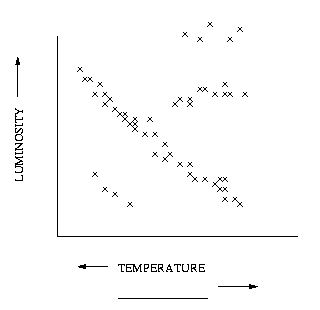
- for MS, HIGHER TEMP = HIGHER LUMINOSITY, and vice versa
- H-R diagram is snapshot of stars of many ages:
most stars spend most of their lives along MS
- in most cases, might as well replace temperature with mass!