Lecture 25. Celestial Distances
Lecture 25. Celestial Distances
 A. Class Business
- TWO activities today! (= short lecture!)
- DON'T follow schedule given at class start...
Read only what's explicitly assigned in class!
- Reading for Fri.:
- HANDOUT
- Section 21.2
- Box on p.444
- STAR PARTY Friday, 7/30, 10:00 p.m., Museum of Rockies
-
TWO TALKS* -- TODAY!
- turn in OUT-OF-CLASS ACTIVITY papers next MONDAY, 8/2
B. Stars' Names
- Greek and Arabic names -- e.g., Altair, Alcor, Aldeberan
- ranking by brightness -- Greek letter in name, e.g.
 -Centauri
- numbered by RA from start of constellation -- 51 Pegasi
- more catalogs: HD #'s, HR #'s, etc.
- Charles Messier's "fuzzy things that aren't comets:" M #'s
-- now know most are nebulae or galaxies
- New General Catalog: NGC #'s
C. Astronomical Distances
Q: HOW BIG IS THE UNIVERSE?
A: Assume it's as big as the distance to the farthest thing
we can see.
Q: How can we tell how far away things are?
A: Using a CHAIN of distance indicators, we can "bootstrap" from nearer to farther objects.
- PARALLAX: near to 1000 ly (from < 4 ly until 1800's!)
- H-R DIAGRAM: similar range; uses
luminosity classes*
- OPEN STAR CLUSTERS (for Fri.): proper motion gives disance, hence absolute luminosity
- RR LYRAE: near to 2 million ly (in clusters)
-
CEPHEIDS*:
near to 60 million ly
- SUPERNOVAE ("secondary"): several Mpc
-- about as far as observed!
(Alter an intermediate step, alter all others beyond it!)
D. Interstellar Gas & Dust
WE CAN SEE BEAUTIFUL CLOUDS IN THE NIGHT SKY. WHAT ARE THEY?
A: NEBULAE -- collections of gas and dust
(singular: nebula)
- GAS CLOUDS lie between stars --
too boring to have you read, but still should know!
- gas is hydrogen (neutral & ionized) and helium
- detected by spectral lines (excited by nearby stars'
radiation)
-- if visible, then called EMISSION NEBULAE
- these gases CONDENSE to form stars ("stellar nurseries")
-- this is what the solar nebula was made of!
- Large clouds of DUST also lie between stars
- dust ABSORBS or SCATTERS light, causing EXTINCTION
-- if scatter is visible, called REFLECTION NEBULAE
- (gases don't absorb enough; must be dust)
- blue light scatters most, so scattering causes REDDENING
-- blue removed from light ("DE-BLUE-ING")
- similar to red sunset, but GAS, not dust, scatters in sky
- (where does blue light go? to making the sky blue!)
-
APOD!*
E. Cosmic Rays
VERY HIGH ENERGY PARTICLES REGULARLY HIT THE EARTH. WHERE DO THEY COME FROM?
A: FROM SUPERNOVAE, MOSTLY WITHIN MILKY WAY.
- mostly collision fragments:
- protons -- fragments of H
- simple nuclei (Li, Be) -- fragments of larger nuclei (C,O)
- other, exotic subatomic particles (positrons, muons)
- trajectories altered by magnetic fields --
recall "plasma frozen to flux:"
charged particles move along magnetic fields, like beads on string
- most are from within Milky Way
- prob'ly caused by supernovae, don't know exactly how
- (highest energy cosmic rays are beyond our ability to create)
F. Extrasolar Planetary Systems
- planet inferred with Doppler shifts from central star's motion
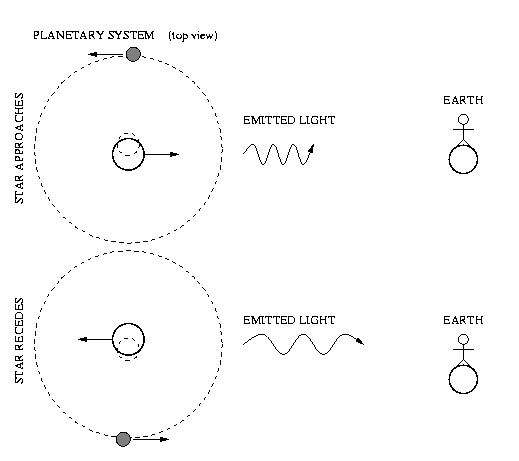
- star doesn't move much due to planet
- larger, closer planet pulls star harder = star moves faster
-- easier to find larger, closer planets
- closer planets orbit faster = see Doppler shifts change more quickly
-- another reason closer planets are easier to find
-
Marcy's web page* summarizes these ideas
- recently, have seen protostellar disks with gaps
"swept out" by planets:
APOD!*