Lecture 3b2 Stellar Parallax not seen.
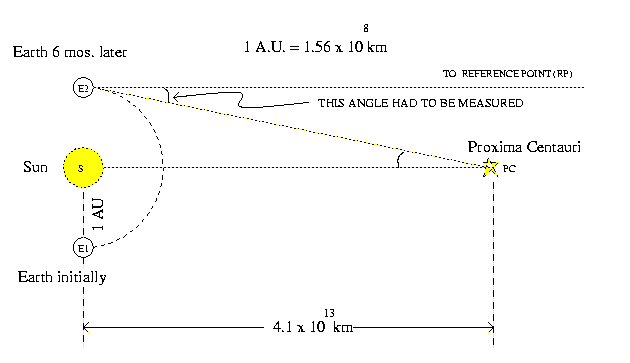
 The angular measurements required to detect parallax must be more precise for
objects far away than for nearby objects.
The angular measurements required to detect parallax must be more precise for
objects far away than for nearby objects.
They were too precise for the ancients, even for
Proxima Centauri,the closest star system to the Earth.
- Angle (E1-PC-E2) had to be measured.
- Geometry shows that angle (RP-E2-PC) is half angle (E1-PC-E2).
- Geometry also shows that angle (E2-PC-S) equals angle (RP-E2-PC).
- Trigonometry shows angle (E2-PC-S) equals distance (S-E2) divided by distance (S-PC).
- (S-E2) = 1.56 x 10⁸km, and (S-PC) = 4.1 x 10¹³, angle (E2-PC-S) = 3.8
x 10-6 radians
- converting this to degrees (x 360/6.28) gives 2.2 x 10⁻⁴
- converting this to arc seconds (x 3600) gives .78'' accuracy required to see parallax
- due to Earth's rotation, stars move about 15'' across sky each second of time
Because the stars are so very far away, these measurements must be so precise
that parallax was not actually measured until 1837.