1. In the space next to each statement, write either "T" for TRUE, or "F" for FALSE. (2
pt. ea.)
T: Objects emit at least some radiation at all wavelengths.
F: We see objects around us because they emit radiation according to their temperature.
F: The wavelength of absorption & emission lines depends on temperature.
2. In each sentence below, circle the correct term in parentheses. (2 pt. ea.)
a. Given a source of emitting atoms, if the number of emitting atoms is doubled,
intensity is multiplied by (two/four). A: two
b. Given a source of emitting atoms, if the source is moved half as far,
intensity is multiplied by (two/four). A: four
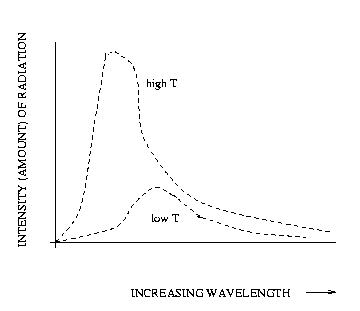
c. Higher temperature objects emit the most radiation at (longer/shorter) wavelengths. A: shorter
d. Higher temperature objects emit (more/less) radiation. A: more
3. Place a check next to two properties that apply to light. (4 pt.)
not true: always acts like a wave
not true: always acts like a particle
TRUE: sometimes acts like a particle, sometimes like a wave
not true: its speed is larger for greater wavelengths
not true: its speed is smaller for greater wavelengths
TRUE: its speed is constant for all wavelengths
4. Sketch a black body curve (2 pt). Bonus: Label the axes. (4 pt)