I. For each question below, answer T for TRUE or F for FALSE.
T: The primary reason stars' spectra differ is
the stars' different temperatures. (COMPOSITION IS ESSENTIALLY SAME)
F: A magnitude 15 star is brighter than a magnitude 10 star (when viewed at the same distance). (MORE POSITVE # = DIMMER STAR)
F: A star's luminosity depends on how far away the star is.
(LUMINOSITY is how much energy star gives out, not how bright it appears to us)
II. Circle the term in parentheses that makes each sentence below correct.
1. Stars' "(radial/proper) motions" are their changes in position
as we see them in the night sky. (PROPER)
2. Spectral lines from rapidly rotating stars are (narrower/wider)
than lines from slow rotators. (WIDER)
3. A pair of stars that appear near each other in the sky
and orbit each other (an optical double/a visual binary).
(A VISUAL BINARY)
4. If two stars form an eclipsing binary system, astromomers can determine each star's (diameter/mass).
BAD QUESTION: CAN FIND EACH STAR'S MASS AND DIAMETER FROM ECLIPSING BINARIES.
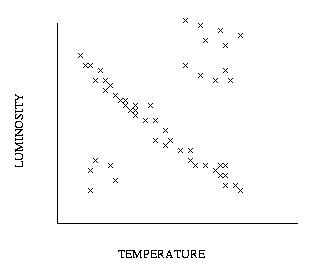
III. On the Hertzprung-Russell (H-R) diagram below, label the direction of increase on both axes with an arrow (i.e., point one arrow in the direction of increasing temperature for the horizontal axis, and one toward increasing luminosity for the vertical axis).
ANSWER: TEMPERATURE INCREASES TO LEFT; LUMINOSITY INCREASES UPWARD
QUESTION: What is the long band of stars that runs from upper left to lower right called? MAIN SEQUENCE