The Relationship of Active Region Magnetic Fields to Coronal
Heating and Solar Flares
ABSTRACT:
This summer's work consisted of 3 related projects. In the first we used
a data set consisting of HSP magnetogram images taken a short time before
a flare and MCCD images of the flare. We then looked at different parameters
such as gradient of alpha, gradient of Bz, and distance from an alpha inversion
line, and correlated those parameters to the occurance of the flare. We
found that flares occur close to alpha inversion lines. In the second study
we used a dataset consisting of hsp magnetograms bracketing a flare image.
The hope had been to show that alpha gradients became smoothed out, via
a process similar to taylor relaxation, after the flare. We were only able
to find 6 examples for our dataset and were unable to show that this occured
with so small a sample. Finally we did a study similar to that done by
Fisher et.al. to see whether alpha variance was related to x-ray luminosity,
which would have been an indication of coronal heating by nanoflares.
INTRODUCTION:
Much of the work this summer concerns the parameter alpha, which is given
by the equation alpha*B=Curl(B). Alpha is a measure of the helicity, in
the form of twist, in the magnetic fields. Last year we found that active
regions where the variance of the alpha distribution reduced more released
more energy in the form of flares than those regions with small or positive
changes in the variance of the distribution This was taken to be evidence
that a kind of relaxation, Taylor relaxation, is occuring in the sun. In
this process a state where all of the magnetic field lines have the same
value of alpha is a stable low energy state (in the same way that many
objects at different temperatures try to reach the the same temperature).
Thus the distribution narrows as the fields converge to such a state. And,
as indicated by the correlation with energy, the excess energy is released,
at least partially, in the form of solar flares.
The gradient of alpha should be related to the variance of alpha. Areas
with a high gradient in alpha would have disperate alpha values and would
then produce a wider distribution. Our first study was to see whether those
local gradients of alpha, that had a wide distribution, were inclined to
relax to a narrower distribution through the production of solar flares.
In the second study we looked at whether the local gradients in alpha got
smoothed out over time. The first study attempted to show that the gradients
are actually involved in causing the solar flare, whereas the second attempted
to show that the release of energy, whether caused by the alpha distribution
or not, changes the distribution in a predictable way.
In addition to being a factor in flare production, a relaxation process
depending on the alpha distribution could also be a factor in coronal heating.
One theory for coronal heating says that nanoflares may be a contribution.
These flares are the result of reconnection on a small scale. As flux tubes
become tangled by convective motion in the photosphere magentic reconnections
will occur. If twist is a factor in reconnection, stressed regions with
different twists in neighboring flux tubes being more likely to reconnect,
then we should find that the wider the distribution of alpha values the
more coronal heating (in the form of x-ray luminosity) should be observed.
This is the purpose of extending Fisher's study to include alpha.
INSTRUMENTATION AND PROCEDURE:
The two instruments used were the Haleakala Stokes Polarimeter (HSP) and
the Mees Imaging CCD spectrograph (MCCD). The HSP determines the magnetic
field vector from a simultaneous measurement of the four stokes parameters.
It takes approximately one hour to produce an HSP magnetogram. The data
from HSP had been previously reduced by Dibyendu Nandi. The MCCD instrument
observes the sun in a range of wavelengths around the Hydrogen Alpha absorbtion
line. The result is a data cube with the two dimensional image and a third
dimension for the wavelength. It takes about 20 seconds to produce an MCCD
scan, and that is about the interval between MCCD frames while the instrument
is running.
For both studies we spatially aligned the MCCD and HSP images using an
IDL routine called setpts. The program performed a least squares fit to
points corresponding to features flagged by the user in both images. The
result is a transform for stretching and reorienting the image, which can
be used as a parameter in other IDL routines, such as poly_2d. Because
the resolution of the HSP is courser than that for the MCCD an interpolation
was necessary to coregister the image. The method used was a two dimensional
bilinear interpolation, and it was confirmed for several examples that
the interpolation accurately represented the HSP image on the scale of
the MCCD image. The errors involved would create different values, however
since we were looking at trends it was most important that the high values
remain high and the low values remain low, and this was the case.
We created two data sets and defined a flare region for each. For the first
study, which attempts to show gradients in alpha causing solar flares,
we found 30 examples of HSP images taken shortly before an MCCD image involving
a solar flare. The times for the start and end time of the flare were taken
from the GOES data. We chose an image near the start time, visually inspecting
to find if there were an earlier time that could be chosen in the H-alpha
image so that we could find where the flare had started. We used a difference
image for this start-of-flare image subtracting a preflare image, and integrated
over the blue wing of the H-alpha to get the flare difference image for
use in this study. We defined the flare to occur in those pixels where
the intensity was 3 standard deviations greater than the mean intensity
in the difference image, over those pixels where the parameter of interest
was measurable and not counting negative pixels which were masked out.
Some pixels would not have measured values of the parameter since the HSP
magnetogram may not have covered the same area as the MCCD image, and when
studying alpha we use a cutoff in the magnetic field to reduce noise, which
results in pixels without defined alpha values. Negative pixels would be
the result of motion of small oscillations in the instrument and of the
active region. The mask used removed all pixels surrounded by more than
3 negative pixels as well, in order to be conservative in determining the
location of flares.
In this study, when looking at the BZ gradient we only used 15 of the regions.
Since there it doesn't make sense to use a B_trans cutoff to eliminate
noise we had to choose regions that were within 25 degrees of the latitude
and longitude of the center of the solar disk to ensure the most accuracy
in the Bz measurement. For the magnetograms in this study the center was
generally within the 25 degree cutoff, but there were parts that extended
as far as 40 degrees from the center of the solar disk in latitude or CMD.
Most regions were wholly confined within the 25 degree cutoff.
In the second study we found only 6 regions for which there we had an HSP
image, followed by an MCCD image of a flare, followed by another HSP image
all taken within a 24 hour time frame so that our observations would not
be affected by the normal evolution of the alpha distribution in the region,
which occurs on a timescale of 27 hours. For this study we took all MCCD
images occuring during the time of the flare and subtracted a preflare
image from each. We integrated over the blue wing of the H-alpha line and
Summed the images from the start time of the flare to the end time, to
get an image showing all the areas of the region that were affected by
the flare. Again, we defined the flare pixels to be those pixels that were
3-standard deviations above the mean intensity in the integrated difference
images.
In both studies we were interested in finding the local alpha and BZ gradient.
To do this we used a scheme in which we found the magnitude of the gradient
between the pixel of interest and each neighboring pixel, then averaged
over all neighboring pixels that had measured values. The gradients were
calculated in the HSP image and transformed to the MCCD image. In the case
of the alpha gradients a cutoff in Btrans of 300 Gauss was used in order
to reduce noise. In this case an alpha gradient was only calculated if
3 or more surrounding pixels had alpha values.
The other parameter that was explored in the first study was the distance
from an inversion in alpha at which a flare occured. The calculation in
this case was done by assigning a value of 0 distance to all pixels in
a magnetogram that had a neighboring pixel with a value of alpha with opposite
sign. The position of the 0 distance pixels were recorded and the distance
was found between these pixels and all other pixels. The distance to the
inversion was the distance from the pixel of interest to the nearest of
the inversion (0 distance) pixels. These calculations of gradients
and inversion distances were tested against test magnetograms to ensure
their accuracy, even after being run through the coregistering and interpolation
program responsible for overlaying the HSP contours on the MCCD image.
In the statistical study of the x-ray luminosity and its relationship to
alpha and related parameters we used the same data set used by Fisher et.al.
to get the x-ray luminosity (Lx) values they obtained from Yohkoh SXT observations.
The data for the parameters we studied,the mean of alpha (<|a|>), variance
of alpha (var(a)), mean of Bz (<|Bz|>) and variance of Bz (var(Bz)),
were derived from the HSP magnetograms corresponding to the regions in
the Fisher data-set. To reduce noise we only considered alpha values in
pixels where the tranverse magnetic field value, B_trans, was greater than
300G.
RESULTS AND ANALYSIS:
I will discuss the results of the second study first since they are the
most straightforward. This was the study that used an HSP-MCCD-HSP set.
The analysis here involved defining a flare area and a nonflare area. The
flare area was that area where the intensity in the integrated difference
image was 3-sigma greater than the mean intensity in that image. The non-flare
area was everything else. We found the mean and variance of the alpha distribution
in the flare area and the non-flare area in the before and after magnetograms.
We did not find any evidence that the variance in the flare area was dropping
relative to the non-flare area. We also found no statistically significant
pattern for a drop in the mean or variance of the magnetic field in these
areas.
One reason for our failure to detect the expected pattern may be the presence
of emerging flux in these regions, such flux would emerge twisted and increase
the dispersion in the alpha distribution, mitigating the effects of flaring
in narrowing the distribution. Another possibility is that these effects
on the alpha distribution are not local, but are distributed somehow throughout
the region. And another is that no such relaxation occured in these particular
regions for one reason or another. In any case, six regions is a small
sample and it would be difficult to go too far with speculation here.
In the first study, to determine where the flare occured in relation to
certain points in the spatial distribution of the parameters we looked
at, for example, close to a high alpha gradient, several methods of analysis
were used. One method was to use spearman's nonparametric rank correlation
statistics. Another was to define a high value of the parameter in question
to be one which is greater than the mean value of that parameter taken
over the whole image. We can then find the percentage of flare pixels,
(those having an intensity 3-sigma greater than the mean intensity throughout
the image) which have a high value of the parameter. This is a bit haphazard,
since,for example, we don't have a theoretical idea of what would constitute
a high value of the alpha gradient and therefore taking a high value to
be greater than the mean value could be meaningless. However, it does give
a different way of looking at the data, and may avoid complications in
the statistics resulting from the number of non-flare pixels vastly outnumbering
the number of flare pixels.
For each method we do an analysis for each of the HSP-MCCD frames. There
were eight frames per region in order to be sure that the result stayed
consistent over the eight frames taken about the start time so that we
knew we were not observing some transient event that only looked like a
flare in one image. These eight frames were eight MCCD images seperated
by an interval of about 20 seconds each (so spanning about 2-3 minutes),
near the start of the flare. The same HSP data was used for each frame
since the HSP data was taken much less often. In addition to doing
the analysis by frames within regions we took the whole dataset and could
do an analysis over all the regions by combining all the pixels into one
set and doing the statistics that way.
The following table is a summary of the results of the analysis by region.
showing, the number of regions for which the correlation was positive,
negative, no correlation, or unclear (varying by frame).
TABLE 1: Results of analysis by region Correlation
| Study | + correlation | - correlation | no/unclear correlation |
| Alpha gradient | 14 | 7 | 9 |
| Bz gradient | 9 | 3 | 3 |
| Inversion Distance | 4 | 14 | 12 |
A region was said to have a positive correlation if 7/8 of the frames showed
a significant (95%) positive correlation. If 7/8 showed a significant negative
correlation the region was said to have a negative correlation. If there
were no significant correlations or if there was a mix of correlations
depending on the MCCD image used then the region has no correlation or
has an unclear correlation. The reason for the large number of unclear
correlations in the study of distance of the flare from an alpha inversion
is that there is a small bug in the program that calculates the spearman
correlation when the number of elements in the arrays to be correlated
is between 20,000 and 30,000. This bug does not affect our other correlations.
This is unlike the case of the alpha gradient where the unclear correlations
occur because the correlation is not statistically significant.
The negative correlation in the inversion distance study shows flares occur
closer to alpha inversions. The Bz gradient study shows that flares occur
where the Bz gradient is high. The Alpha gradient study is inconclusive
here. A somewhat different perspective can confirm these interpretations.
Table 2 indicates the number of regions for which greater than 50% of the
flare pixels occured at a high value (greater than the mean value) of the
parameter.
TABLE 2: percent of flare at high values of the parameter
| Study | > 50% | < 50% | Varies by Frame |
| Alpha gradient | 4 | 17 | 9 |
| Bz gradient | 13 | 0 | 2 |
| Inversion distance | 25 | 0 | 6 |
This indicates a strong trend for the flare to occur close to a point of
an alpha inversion and where the Bz gradient is high. However, according
to this analysis, the gradient of alpha is not important. In this analysis
the "greater than 50%" in the inversion study indicates that a majority
of flare points were closer to the alpha inversions than average, whereas
in the gradient studies the percentage is those pixels having gradients
greater than the average gradient. This method is not particularly rigorous
since we have no way of defining on physical grounds what a large gradient
or a close distance should be. As such the results summarized above should
be considered for their perspective rather than as conclusive, statistically
significant results.
We can do the analysis over all frames as well. The results of this analysis
are summarized in table 3.
TABLE 3: Study of Correlations and Percents over all frames
| Study | percent | correlation coefficient | significance |
| Alpha gradient | 32.371% | 0.0911 | 0.000 |
| Bz gradient | 48.607% | 0.0828 | 0.000 |
| Inversion distance | 90.152% | - 0.0520 | 0.000 |
In the above table a significance of 0.00000 probably indicates that the
the confidence is very high, such that an underflow error occurs leading
to a calculated confidence of 100%.
Table 3 shows that we can have confidence that the distance to the inversion
is correlated with flare occurence since both the percent study and the
correlation study lead to this conclusion. In the case of the Bz gradient
we were inclined to believe the correlation rather than the percent argument.
Since the mean gradient of Bz is not necessarily a physically significant
parameter, and because the percent close to 50%, (in a way a 'no correlation'
percentage) The significant and positive correlation coefficient can be
taken to show that areas with a high Bz gradient tend to produce flares.
The Alpha gradient parameter was somewhat more complicated since the percent
method has a very low 'correlation' and the spearman's method shows a significant
positive correlation. Once again, we were inclined to dismiss the percent
study for its haphazardness and believe the correlation coefficient. We
also did a check on this by looking at the correlation for different cutoffs
in B_trans. These results are summarized in table 4.
TABLE 4:alpha gradient correlations, all frames with different B_trans cutoffs.
| Cutoff | Correlation Coefficient | Significance |
| 250 G | 0.000290 | 0.986 |
| 300 G | 0.0911 | 0.000 |
| 350 G | 0.127 | 0.000 |
These results show that as the cutoff is raised the correlation becomes
stronger. This is what would be expected of a real correlation since the
lower the cutoff the noisier the data. We can do a similar thing for the
study of the distance that a flare occurs from an alpha inversion. The
results are summarized in table 5:
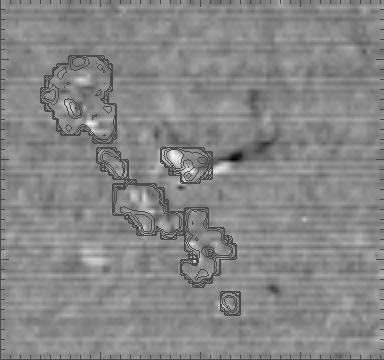
This image shows the contours of the gradient of alpha overlayed on
an image of
active region 6919 during the early stages of a flare. Notice that
the flare occurs
in an area where the gradient in alpha is at a peak.
TABLE 5:Inversion distance correlations,all frames with different B_trans cutoff
| Cutoff | Percent | Correlation Coefficient | Significance |
| 250 G | 79.75% | -0.0240 | 0.000 |
| 300 G | 90.152% | -0.0520 | 0.000 |
| 350 G | 91.93% | -0.133 | 0.000 |
This table indicates that the correlation between the
distance from an alpha inversion is real since as the cutoff in B_trans
is raised, and the noise is reduced, the
correlation becomes stronger. It is encouraging
that the percentage of flare pixels within a less than average distance
from the inversion point is high as well. Though, it is
important to remember that this is not a particularly
meaningful measure since we have no way of defining what it means to be
"close",in the same way that we had no way of defining what a "large" gradient
in alpha was.
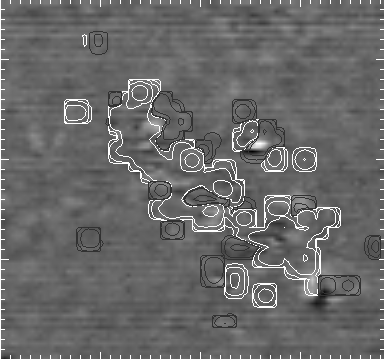
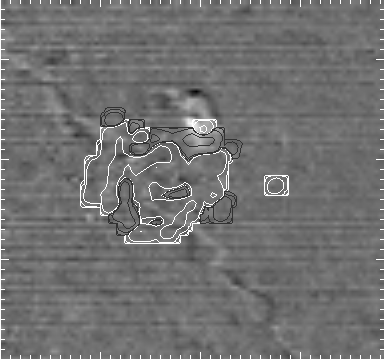
These images show the contours of alpha, with white lines for the positive
values of alpha and dark lines for the negative values of alpha. The left
image is AR 6982 and the right image is 9704. Both show a flares in early
stages starting near alpha inversion lines.
For the final study, the x-ray luminosity vs. the alpha
and Bz distributions our dataset consisted of 331 active regions for which
we had x-ray data and HSP data. Our approach to this analysis was statistical,
using Spearman's correlation to relate the parameters to the x-ray luminosity.
We observed that the mean and the variance of alpha were strongly related
to the number of points in a magnetogram. The relation between sample size
and the parameter was found to be a powerlaw. To remove this dependence
we defined lamda lamda=X/Y^p ;where X is a statistical quantity and Y is
the dependence that we seek to remove from X. By varying the power p until
We get a spearman's coefficient of 0.0 with low confidence between lamda
and Y, we could find a lamda that represented X independent of Y.
For alpha it was necessary to determine the nature of the dependence on
the sample size. It turns out that for a normal distribution a small sample
size will underestimate the variance. This is because if one takes sample
points out of a parent distribution the most likely thing is that they
will be at the center of the gaussian curve. As the sample size increases
the sample will better represent the parent distribution and the sample
variance will converge to the population variance. Using a random number
generator we could test to see how many points was necessary to get a convergent
variance in a gaussian distribution. We found that a sample size of the
order of 100 would be sufficient. Since much of our alpha data had fewer
than 100 points we removed the dependence of points from the whole dataset
for the parameters <|a|> and var(a).
The variance of alpha also has a physical dependence on the number of points.
The variance of alpha would be expected to be correlated with the mean
of alpha since a greater value of alpha would have more room for variation.
The mean of alpha has a dependence on the strength of the magnetic field.
A high magnetic field prevents the flux tubes from being twisted as much,
so low magnetic fields have higher values of alpha than high magnetic fields.
It turned out that regions with many pixels had a higher ratio of Low B
to high B pixels, so on average more pixels meant a higher ratio of points
with a greater twist to points with a lesser twist. This produced a dependence
of the variance of alpha on the number of points in addition to the statistical
dependence. This cross correlation was removed by removing the dependence
of the variance of alpha on points at the same time that the statistical
dependence was removed.
Lx also would have some dependence on the number of points, but in this
case the reason is physical and not statistical. Lx is given for a region,
so it would be dependent on the area of the region. The area of the region
is strongly correlated with the total magnetic flux from the region. If
the total magnetic flux is higher then there will be more points in a magnetogram
with a B_trans value above 300G. We expect, and find, that this causes
a positive correlation between Lx and the number of points in the magnetogram.
The Bz distribution is also subject to certain systematic influences. The
Hsp magnetograms come in two resolutions 5.656 arc-s per pixel and 2.828
arc-s per pixel. The lower resolution was often used to observe regions
which were large and could not fit in the field of view of the high resolution
image. Generally the high resolution setting was the default. A consequence
of this is that the Total flux, and the average value of Bz in the low
resolution magnetograms is systematically higher than in the high resolution
magnetograms. Another consquence is that since there are more points in
the high resolution magnetograms there could be a statistical correlation
due to undersampling. To mitigate the effects of this discrepancy the Bz
data was split into two groups based on the resolution used. We also tested
the average mean of Bz and the average variance of Bz in the two datasets
and found there was such a discrepency, but there was no significant difference
in the mean or variance of alpha between the two sets. This indicated that
our reasoning about the systematic difference due to preference for a resolution
when viewing a region of certain size is correct. The analysis then proceeded
as usual with the finding of Spearmans correlations. The Results of these
correlations are summarized in Tables 6 and 7.
TABLE 6: Correlations involving alpha and X-ray luminosity
| Parameters | Correlation Coefficient | Significance |
| Lx, var(alpha) / pts ^ 1.69 | 0.108 | 0.050 |
| Lx / pts ^0.619 , var(alpha)/pts^1.69 | 0.139 | 0.011 |
This table indicates that the variance of alpha is moderately correlated with the x-ray luminosity, and the correlation is significant.
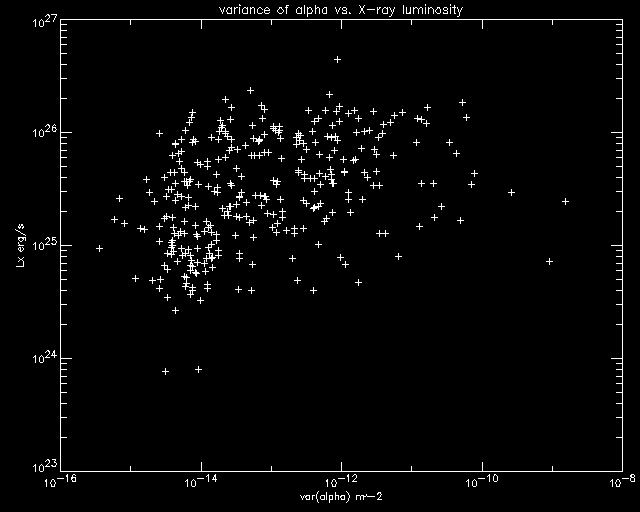
This plot shows the relation between the variance of alpha and the X-ray luminosity before the dependences on the sample size are removed.
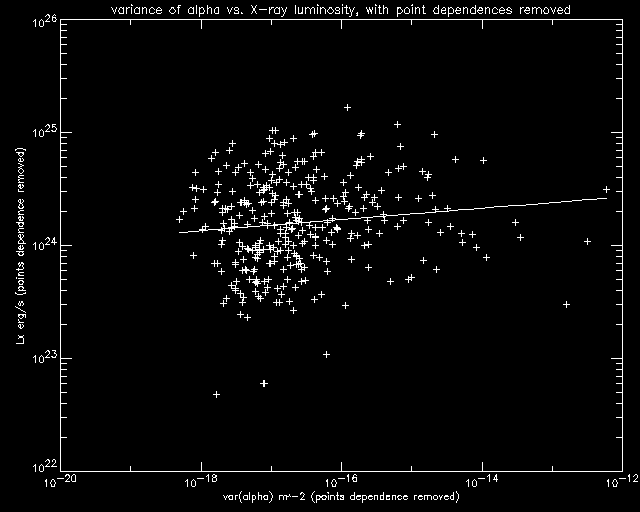
This plot shows the relation between the x-ray luminosity and the variance
of alpha after the sample size dependences have been removed.
The line represents a best-fit for a powerlaw.
TABLE 7: Correlations involving Bz and X-ray Luminosity
| Parameters | Resolution | Correlation Coefficient | Significance |
| Lx, <|Bz|> | 5.656 arcseconds / pixel | 0.641 | 1.52e-10 |
| 2.828 | 0.666 | 1.56e-33 | |
| Lx/ Area, <|Bz|> | 5.656 | 0.320 | 0.004 |
| 2.828 | 0.388 | 1.83e-10 |
Table 7 indicates that the mean of Bz is correlated with the x-ray luminosity and the x-ray luminosity per unit area. We can be confident in these results since spearman's coefficient is very similar between the high and low resolution datasets.
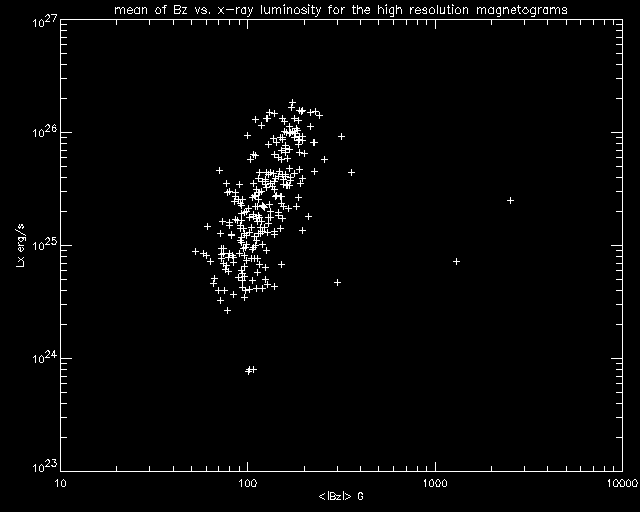
This plot shows the strong positive correlation between the mean of Bz
and the x-ray luminosity for the case of the 2.828 arcsecond per pixel
resolution magnetograms. the other plots look very similar.
DISCUSSION:
The triplets study does not show any smoothing in the alpha gradient in
region where a flare occurs. Such a smoothing would have been expected
if the reconnection that takes place in flares is causing the twist to
be more uniform in the flare area of the region. In all six cases we found
the opposite to be true, to some extent. However, there are processes which
could have caused the measured alpha variance to increase even as the reconnection
sought to drive the region to a uniform twist value. If flux emergence
is occuring this is a possible source of new and disparate twist values.
Flux tubes rising into the photosphere will emerge highly twisted because
of buffeting in the convection zone. Flux emergence would have the effect
of canceling out any reduction in the dispersion of alpha values due to
reconnection. The size of the dataset is too small to determine the cause
of the alpha gradient not smoothing or determine conclusively that the
alpha variance does not, in fact, decrease.
The doublets study showed that in a large sample of 30 regions and many
frames (8 per region), there were several factors that influenced where
a flare would occur: the alpha gradient, Bz gradient, and distance from
an alpha inversion line.
The distance from the alpha inversion line seems to be the strongest indicator
based on this data. Looking at individual regions shows that more regions
have flares that occur close to alpha inversion lines than regions have
flares that occur further away. This is somewhat complicated by the unfortunate
error in the IDL code for finding the spearman's correlation for certain
sizes of datasets so that the rho value is spurious (|rho| > 1.0). However,
in the measureable regions the numbers were 14 to 4 and for the somewhat
ad hoc percentage idea 25 regions showed a flare occuring closer to an
alpha inversion than the average distance of any pixel from an inversion
point, with several regions having an insignificant correlation or varying
based on frame. When all of the frames are put together to form a larger,
and statistically more reliable set of data, we found that there is a strong
correlation showing that the flares occur close to alpha inversions. This
correlation becomes stronger as the transverse magnetic field cutoff is
increased, reducing the noise and increasing confidence in this result.
The alpha gradient correlation is not borne out in the individual regions,
however an analysis over all frames indicates that there is a positive
correlation between the alpha gradient and image brightness. Meaning that
points with a higher alpha gradient were more likely to have flares occur
than those with low alpha gradients. This correlation becomes stronger
as the transverse magnetic field cutoff is increased. In the case of alpha
gradients the percentage of flare pixels occuring above the mean alpha
gradient is smaller than the percentage occuring below the mean alpha gradient,
however, this is such an arbitrary measure that we should not be concerned
about it. We have no theoretical idea of what should constitute a high
alpha gradient versus a low one and therefore this measure is fairly meangingless.
If it supported our conclusion reached by more rigorous statistical methods
it would add confidence to the results, but not supporting well established
methods does not detract from the certainty of the results.
For Bz gradients we found that for individual regions the points where
the Bz gradient is high are more likely to have flare. Doing the analysis
over all the frames shows the same correlation. The percentage measurement
shows that about 50% of flare pixels occur at high Bz gradients, so this
neither adds confidence in the correlation measurements or detracts from
it.
The results of the doublets study show that the alpha distribution has
effect on reconnection and the production of solar flares. It seems based
on this study that opposite handedness of the twist is more significant
than the actual gradient in the twist to driving solar flares.
The study that is an extension of the work done by Fisher et.al. Shows
that there is a significant positive correlation between the variance of
alpha and the x-ray luminosity, as well as between the mean of the amplitude
of Bz.
In the case of the variance of alpha versus Lx it was necessary to remove
the dependence of alpha and Lx on the number of points. In the case of
Lx this was removed in order to remove the effect of a cross correlation
with the area of the active region. Since for a larger area one would measure
a larger value of Lx and find more points above the B_trans cutoff removing
this points dependence eliminates correlations through a dependence of
Lx and alpha on the number of points.
The dependence of the variance of alpha on points is a more complicated
matter having two sources. First is statistical undersampling. If the parent
distribution of alpha values is normal then choosing a small number of
points at random from the distribution (which is essentially what we do
with the 300 G cutoff) means that for small samples the sample variance
will be an underestimate of the population variance. This is because the
most probable values are those near the peak of the distribution, which
is narrow.
The other dependence that the variance of alpha could have is a more physical
one. The variance of alpha should have some dependence on the mean of the
amplitude of alpha. In fact, we found using a spearman's correlation that
the coefficient for this correlation is 0.966 with a significance of 0.00.
This is because a large value of alpha has more room to fluctuate than
a small value of alpha, therefore the dispersion will be larger. It turns
out that when there are more points in a magnetogram the mean of alpha
is larger. This is because alpha values are dependent on the strength of
the magnetic field. In a region with a strong magnetic field it is difficult
to twist the magnetic field lines, so alpha is low. In a region with a
weak magnetic field alpha will be higher. Because we use a 300 G cutoff
regions with a small number of points have a tendency to preferentially
have higher magnetic field values since the sample mean could be in the
wings of the distribution (say the 300 G region results from a small area
of unusually high magnetic field), it may not converge to the population
mean. However, in regions with a large sample size there will be a more
diverse measure of Bz, which will result in many more pixels of relatively
small Bz (and large alpha).
Since both of these influences affect the variance through a dependence
on the number of points in the magnetogram we removed the dependence of
the variance of alpha on the number of points and find a positive correlation
with the x-ray luminosity. This positive correlation shows that alpha is
an important factor in coronal heating, probably effecting heating through
nanoflare events.
CONCLUSION:
Six regions is insufficient to draw a conclusion on the evolution of the
alpha distribution in a region from before a flare to after a flare.
Alpha may be important in some way in driving solar flare production. Places
where there are high alpha gradients or alpha inversion lines tend to produce
more flares than those where there are weak alpha gradients or values of
alpha of the same sign. The variance of alpha is significantly correlated
with coronal heating. Probably by being a factor in reconnection and releasing
energy in the form of nanoflares.
-----------------------------------------------------------------------------------------------------------------------------------------------------------------------------------------------------------------
Appendix...
More Interesting Correlations:
| Parameters | Correlation Coefficient | Significance |
| Lx, <|alpha|> | 0.321 | 2.38x10^-9 |
| Lx , <|alpha|> with points dependence removed from each | 0.0575 | 0.297 |
| Lx, var(alpha) | 0.4127 | 4.77x10^-15 |
| Lx, var(alpha) with points dependence removed from each | 0.139 | 0.011 |
| var(alpha), number of points | 0.622 | 7.88x10^-37 |
| Lx , number of points | 0.53961 | 2.07x10^-26 |
| Lx, Bz (high resolution) | 0.666 | 1.56x10^-33 |
| Lx, Bz (low resolution) | 0.64095 | 1.52x10^-10 |
| <|alpha|>,pts | 0.543 | 7.82x10^-27 |
| var(alpha),<|Bz|> | 0.450 | 2.66x10^-22 |
| <|Bz|>,number of points | 0.788 | 0.0000 |
| var(alpha) with pts dependence removed, <|Bz|> | 0.0267 | 0.628 |
| var(alpha), <|Bz|> with points dependence removed from each | 0.0752 | 0.172 |
| Lx / Area, <|Bz|> high resolution | 0.388 | 1.83x10^-10 |
| Lx / Area , <|Bz|> low resolution | 0.319 | 0.0038 |
| Lx, Area | 0.830 | 0.0000 |
| Lx/Area , Area | 0.407 | 1.78x10^-14 |
| Lx, Total Flux | 0.835 | 0.0000 |
| Lx / Total Flux, Total Flux | 0.253 | 3.26x10^-6 |
One of the important correlations from this is that the variance of alpha and the mean of Bz are related through a mutual correlation with the number of pixels in the magnetogram. Since this dependence was removed when we found the correlation of variance of alpha with Lx That dependence is independent of the other correlation we found of Lx with the mean of Bz.
Differences between the low and high resolution Magnetograms:
5.656 arcs :
average total flux: 2.41 +/-
0.14 x 10^22
average <|Bz|>
: 119.901
average area
: 3.21+/- 0.16 x 10^18
2.828 arcs:
average total flux: 9.62+/- 0.40 x10^21
average <|Bz|>
: 143.213
average area
: 1.64+/-0.058 x 10^17
This shows that there is a systematic difference between the low and high resolution magnetograms.