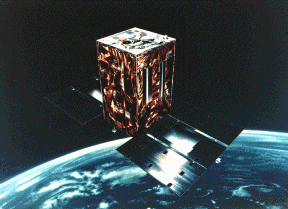
 Yohkoh is a Japan/US/UK mission aiming for the study of high-energy
solar physics. Its scientific operations were conducted since early
September-1991 through 14-December-2001.
Yohkoh was named after the Japanese word meaning 'sunshine'.
Yohkoh is a Japan/US/UK mission aiming for the study of high-energy
solar physics. Its scientific operations were conducted since early
September-1991 through 14-December-2001.
Yohkoh was named after the Japanese word meaning 'sunshine'.

Yohkoh is a Japan/US/UK mission aiming for the study of high-energy
solar physics. Its scientific operations were conducted since early
September-1991 through 14-December-2001.
Yohkoh was named after the Japanese word meaning 'sunshine'.
Yohkoh scientific instrumentation included a Hard X-ray Telescope (HXT), a Soft X-ray Telescope (SXT), a Bragg Crystal Spectrometer (BCS), and a Wide-Band Spectrometer (WBS). These instruments are described in a series of papers in Solar Physics, vol. 136 (1991). First results have been published in Publ. Astron. Soc. Japan, vol 44 (1992). A bibliography of Yohkoh-related publications may be found at http://www.lmsal.com/~aschwand/publications/yohkoh.html.
Yohkoh steadily continued its observation more than ten years, and
this made Yohkoh the world's first space mission to provide solar images
over a whole solar cycle. On 14-Dec-2001, however, observing an annular
eclipse, Yohkoh lost its attitude control and became unable to
resume observations.
Signals from Yohkoh was monitored for more than 2 years after the
end of scientific operation. Yohkoh re-entered the earth on
12-Sep-2005 and burned out in the atomoshpere somewhere above the
point (24N, 85E).
For more information about Yohkoh mission, spacecraft, and instruments, we have several versions of documents, including some external links. Hope you find the article that best meets your needs.

