Emily Barrentine
Hi.
I am a REU student in solar
physics at Montana State University this summer and have been working
with Dr. David McKenzie
learning how to use IDL, a programming language, and analyzing two events
that took place on the sun, a 'cusped loop' on October 19, 2000 and the
brightening of a filament channel on January 22, 2000. During the
academic year I attend Bryn Mawr College
just outside of Philadelphia where I am majoring in physics
and possibly minoring in one or two of math, astronomy or philosophy. I
am originally from Deer Park, Washington, a small town just north of Spokane
in eastern Washington. Most of my time at work this summer has been
spent learning how to use IDL to prepare data from the Soft X-Ray Telescope
(SXT) on the Yohkoh satellite,
and making temperature maps of the data to see approximately how the temperatures
in a particular region change and evolve over time. We took these temperature
maps and compared them with the original SXT images, and with images from
the Extreme Ultraviolet Imaging Telescope (EIT)
on the SOHO spacecraft, to
try to come up with a detailed description of what was happening during
these two events.
Cusped Loop
Filament Channel
Cusped Loop on October 19, 2000
17:06 - 17:35 UT
The Sun's magnetic field lines get twisted around because different latitudes
on the sun are rotating at different rates. Sometimes the magnetic field
lines pop out of the surface and reenter at another place on the surface.
The plasma on the sun is forced to move along the magnetic field lines
and so loops of plasma are visible outlining the magnetic field lines.
At the base of these loops, in the photosphere, where the convection currents
carrying energy are deflected by the magnetic field, sunspots form. The
Soft X-Ray Telescope on Yohkoh takes pictures of what is happening higher
up in the sun's atmosphere, in the corona, where the temperature is around
2-20 million degrees Kelvin (the inner layer of the photosphere in comparison
is about 8,000 K). The Extreme Ultraviolet Telescope on SOHO only takes
pictures of the sun around 1.5 million degrees Kelvin. The atmosphere in
the sun is actually hotter higher up, so when you look at EIT images you
are looking further down into the sun's atmosphere.
A cusped loop is thought to form when the magnetic field lines get streched
upward into space by filaments (see an explanation of what filaments are
in the next section) that erupt and send
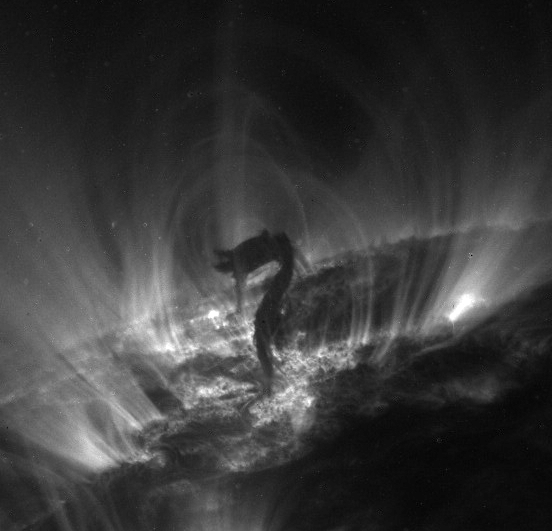
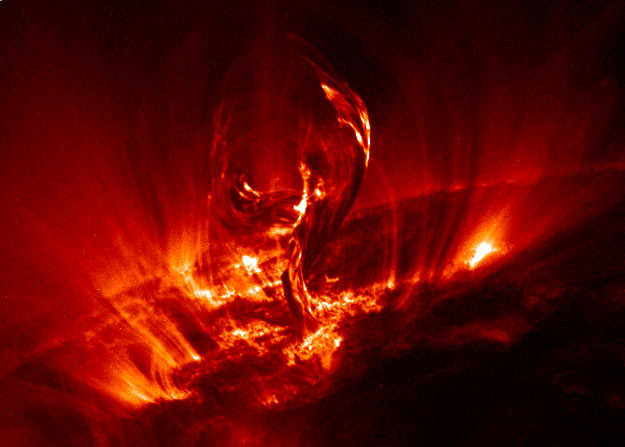
material upward. Here and here
are two pictures of erupting filaments. When this happens the field lines
sometime snap, release energy and throw material out in a 'coronal mass
ejection', before reconnecting. A cusp is seen as a sign that this reconnection
has occured and that material and a magnetic field loop have been thrown
up into space During the reconnection the magnetic field lines are
"open" to space, meaning that even though the magnetic field lines are
still connected to the surface they reach so far up that the plasma is
able to escape into space. The original loop becomes pointed at one end
because as the field lines reconnect their shape is pointed outward. The
magnetic field lines during reconnection look like
this.
For a better description of what is happening in a cusped loop you might
want to read the article which is linked below, but here
and here are two really nice pictures of cusped
loops.
Article
about cusped loop on Oct. 19, 2000
Below are four SXT images,
taken 6-10 minutes apart, of a loop on the western limb of the sun which
formed a cusp on Oct. 19, 2000 (click on the images to enlarge them).
At 17:10 UT, in the first frame, there is just a hint of the cusp structure
coming outward from the loop, but by 17:20 UT you can definitely see the
pointed shape of the cusp heading out and downward from the loop. In the
last two frames, 17:26 and 17:34 UT, the cusp structure becomes more substantial
and pointed and moves further downward so that it is almost completely
level with the bottom edge of the active region.


(above) SXT partial sun images
@ 17:10, 17:20, 17:26 & 17:34 UT with AlMg filter.
-
Light Curve of SXT Images
Below is a
graph of the intensity in the 'A' region, which is where the cusp is forming,
from 17:10 to 17:35 UT. The points at the top of the graph are data
points from one filter, while the points in the lower part of the graph
are data points from the other filter. If one looks at the data points
from each filter separately, the light curve shows the brightening in the
cusp region.


(a)
(b)
(above)
(a) SXT image of cusped
loop at 17:35 UT with black box around cusp region.
(b) Light curve of 'A' region
boxed in (a), showing intensity in region from 17:10 to 17:35 UT.
-
Temperature Maps of SXT Images
The temperature maps below
were made by calculating the 'color temperature' of the SXT images above.
The Soft X-ray Telescope has the option of using five different filters
when it takes its pictures of the sun and each filter lets only x-rays
of a certain energy (or wavelength) through. The sun radiates energy
in approximately a blackbody spectrum and a blackbody of a certain temperature
has a unique distribution of luminosities that it radiates, that is, each
wavelength of radiation has a certain characteristic luminosity as seen
in this blackbody
curve for an object at 6000 K. By looking at the ratio of the luminosities
of the two different filter images, each taken at about the same time,
the IDL program SXT_TEEM can fit the ratio to a specific temperature. The
temperature maps below were made by calculating the ratios of the AlMg
and Al.1 filter images.
Perhaps the most noticeable
pattern that the temperature maps below show, is that the hottest regions
of the cusped loop are always at the edges of the loop and in the cusp
region. These are the only places where the temperature is greater than
106.9 and 107.0 degrees Kelvin. On a whole, the cusp
region seems to be heating up, which is consistent with what one would
expect for a cusped loop, as a lot of energy is being released in this
area when the magnetic field lines reconnect. From 17:10 to 17:20 UT the
entire active region becomes hotter. Also during this time, hot areas begin
to appear in the cusp region, yet there is still a layer of cooler temperatures
between the cusp and the rest of the active region. The whole top part
of the active region cools down from 17:20 to 17:26 UT, while the bottom
right of the region heats up quite a bit. The part of cusp region that
has a visibly hot temperature also narrows at 17:26 UT. From 17:26 to 17:34
UT the top part of the active region heats back up again, but the bottom
right continues to be the hottest area in the active region. It also seems
that in the cusp region at 17:34 UT, the area that before had been the
hottest is now the coolest part of the cusp region, while the areas surrounding
it, which before had been cooler, are now the hottest.


(above) Temperature maps
of cusped loop @ 17:10, 17:20, 17:26, & 17:34 UT with contours
of SXT image. The lightest regions are the hottest and the darkest regions
are the coolest.
(below) Temperature maps
of cusped loop with contours of log of temperature values in Kelvin (same
times).


-
Comparing SXT Images and Temperature Maps with EIT Images
It is interesting to compare
what is going on at 2-20 million degrees K to what is happening at a slightly
cooler temperature of 1.5 million degrees K. Below are some EIT images
taken during the same time period. In the full sun image below there is
a white box around the region where the cusped loop was found in the SXT
images. Below that are the close up images of the boxed region with
contour lines outlining where the SXT images was. The pointy cusp in the
SXT images seems to correspond to a stream of plasma coming out of the
bottom right corner of the active region in the EIT images and this stream
of plasma, when seen on the full image of the sun, is actually the beginning
of big loop that goes far out from the sun and then reenters again a bit
further down. So the EIT images would seem to suggest that the cusped loop
is not a cusped loop at all, but the beginning of a bigger loop. However,
the temperature maps of the SXT images seems to show pretty convincingly
that the outer edge of the cusped loop is heating up. This is wierd because
why would the big loop be very very hot in just this particular region
while on either side it is very cool in comparison. It is possible that
this is a coincidence that the cusped loop happens to be aligned with the
bigger loop in the EIT images and that one is behind or in front of the
other. The EIT images also show another stream of plasma shooting out of
the top of the active region, which does not show up at all in the SXT
images, or on the temperature maps, except in the temperature map at 17:26
UT, where there seems to be a narrow band of higher temperatures in the
top right.

(above) EIT full sun image
@ 17:24 UT with white box around cusp region from SXT images.
(below) EIT partial sun
images @ 17:12, 17:24 & 17:36 UT showing region with cusp and contour
lines of SXT image of cusp.
(even further below) Temperature
maps from SXT images @ 17:10, 17:26 & 17:34 UT with contour lines showing
EIT image of cusp region @ 17:12, 17:24 & 17:36 UT.


Filament Channel Brightening on January
22, 2000 17:58 - 18:09 UT
Filaments are cooler layers of plasma on the sun that get caught higher
up in the sun's atmosphere by magnetic field lines. The magnetic field
line structure that holds the filament up can be made up of a long string
of arched loops outlined by hotter plasma. Here
is a picture of the magnetic field structure surrounding a filament channel.
The filament runs through the middle of this arched structure in the filament
channel. When seen on the limb of the sun, filaments are called prominances.
There is more information on and pictures of filaments and filament channels
here.
On January 22, 2000 in a solar flare region SXT and EIT observed the brightening
of a filament channel that was coming out of the side of the flare region.
This happened once from 8:24 to 10:00 UT and again, right after the solar
flare occured, from 17:58 to 18:09 UT. We think the brightening is heat
being conducted down through the cooler plasma in the filament channel,
which would normally not be visible in the higher temperature SXT images.
For more about this filament channel brightening you should read the article
linked below.
Article
about filament channel on Jan 22, 2000
Below are six SXT images taken two minutes apart of the solar flare region
and the edge of the filament channel on January 22, 2000. At 17:58 UT nothing
is visible in the filament channel area, but at 10:00 UT a stream of plasma
seems to begin traveling out of the lower left-hand corner of the flare
region. The stream in the filament channel moves out further in the next
two minutes and then widens from 18:04 to 18:08 UT.


(above) SXT images of solar
flare region and edge of filament channel @ 17:58, 18:00, 18:02, 18:04,
18:06 and 18:08 UT with AlMg filter.
MPEG movie of event
-
Light Curve of SXT Images
To help see more quantitatively
the formation of the stream of plasma in the filament channel, below is
a light curve of the filament channel region. At around 18:00 UT one can
see the brightening of the filament channel beginning and continuing until
around 18:02 UT when the graph levels off.


(a)
(b)
(above) (a) SXT images of
solar flare region and edge of filament channel at 18:06 UT, with box around
filament channel region.
(b) Light curve of 'A' region
showing change in intensity in filament channel from 17:58 to 18:09 UT.
Here are
the images from EIT of the solar flare region during the same time.
(below) Partial
sun images of the solar flare region, same day, @ 17:48, 18:00, 18:12,
18:24, 18:36, and 18:48 UT.


-
Temperature Maps of SXT Images
Below are temperature
maps of the SXT images, showing the color temperature in the solar flare
region and the edge of the filament channel. This time, the filters used
by SXT_TEEM to calculate the ratio were Be and Al.12 filters. The first
group of temperature maps are contoured with the SXT images on top. From
these maps one notices that the brightest areas in the SXT images are not
the hottest areas on the temperature maps. The brightest region in the
SXT images is always in the center of the solar flare region while the
hottest parts tend to be on the edges of the region. At 18:02 UT, for example,
the temperature map shows a hot layer surrounding the solar flare region
on all sides, yet the SXT image shows the region losing brightness as you
move away from the center. Throughout the time span the SXT images do not
seem to recognize the stream in the filament channel as being that bright,
whereas in the temperature map it grows to be one of the most dominant
features. At 18:02 UT the parts of the filament channel which show up as
bright seem to be the coolest parts of the filament channel, and those
that show up as dim seem to be the hottest.
At 18:00 UT
the heat starts in the lower right center of the solar flare region and
moves first outwards and then down towards the filament channel, a bit
like a wave moving outward from a drop of water in a pond. The filament
channel does not seem to be disconnected temperature-wise from the solar
flare region, but rather it seems that the filament channel is part of
the same system across which heat can travel. At 17:58 UT the hot
parts of the region, with temperatures greater than 107.1 degrees
K, are clustered around the lower right center of the flare region (the
two black splotches in the center are data that SXT_TEEM threw out because
of saturation). By 18:00 UT the bulk of the left side has cooled,
with temperatures now only greater than 107.0 degrees K. The
hot areas in the region are now all along the edges of the flare region,
though especially on the left. By 18:02 UT the hot 'edge' has moved further
out, particularly into the lower right and left and down towards the filament
channel. As the 'edge' has moved further out, the area behind it has cooled.
By 18:04 UT the 'edge' has moved out even further, but has pretty much
dispersed, and the solar flare region has cooled behind it. What before
had been the hot outer edge is now much cooler with only a thin layer of
hot temperatures on its outside. Also by 18:04 UT, the filament channel
has smoothed out and widened on the temperature map. The hottest temperatures
are on the right-hand side of the filament channel, and going up the outer
edge into the flare region. By 18:06 and 18:08 UT the flare region
and filament channel have both cooled off and the temperatures across both
are pretty homogeneous. In fact, through 18:06 and 18:08 UT the temperatures
of the region stay about the same.


(above) Temperature maps
of solar flare region and edge of filament channel @ 17:58, 18:00, 18:02,
18:04, 18:06 and 18:08 UT
made from SXT images using Be and Al.12 filters and with
contours of SXT image .
(below) Same temperature
maps with contours showing log of temperatures in Kelvin.


-
Comparing Images and Temperature Maps with GOES Data
The graph below shows
X-ray counts for the entire sun during the time period from 17:45 to 18:20
UT, when the filament channel brightening took place on January 22, 2000.
The data is from the Geostationary Operational Environmental Satellite
(G0ES), a weather satellite that also has an X-Ray detector that is pointed
at the sun. No other activity was going on at the time, so the graph basically
tells us what was happening in the solar flare region. The graph shows
that the flare started around 17:58 UT and hit a maximum from 18:00 to
18:02 UT, after which it slowly declined. The filament channel becomes
visible in the SXT images around the same time that the solar flare is
at maximum, at 18:00 UT, about two minutes after the flare starts. 18:00
UT is also when the 'edge' begins moving outward from the center of the
solar flare region and eventually down along the outer right edge and into
the filament channel. The hottest temperatures occur from 17:58 to 18:02
UT, during the beginning and peak of the flare and the coolest temperatures
occur from 18:04 to 18:08 UT, during the decline in solar activity.
,
(above)
Plot of GOES data, showing x-ray intensity over total
sun, between 17:45 and 18:20 UT, on Jan-22-00.
The dotted lines mark when the SXT images and temperature
maps were taken, at 17:58, 18:00, 18:02, 18:04, 18:06 and 18:08 UT.
back to top of page
back
to Solar Group Members page
back
to 2001 REU page
last updated July 26, 2001
email: embarren@brynmawr.edu