Daily Log
August 6
A summary of my results can be found here.
July 26
The XRT images were of solar activity on July 8th at 16:00 continuing until July 9th at 6:00. During this time period, there were four flares recorded. The first started at 16:23, reached its max at 16:32 and ended at 16:42. The second flare began at 17:29, reached its maximum at 17:34, and ended at 17:47. The third flare started at 17:48, reached its max at 18:03 and ended at 18:09. The final flare started at 19:21, maximized at 19:24 and ended by 19:28. The graph below shows the X-Ray activity on the sun during this time:
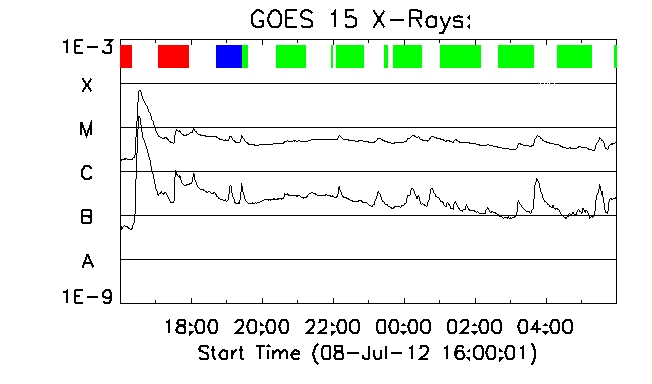
The original set of data was a set of 1812 frames taken in a variety of 2 filter combinations. In order to run XRT Teem, the same restrictions were placed on the selected images as the previous data set. Of the 1812 original images, there were 776 images which fit the restrictions. The restricted images were 384 x 384 pixels and had one of the following filter combinations: Open/Al_mesh, Open/Ti_poly, Open/Al_thick or Open/Be_thick. The time at which these images were taken can be seen on the graph.
To create the temperature maps, two sets of filter wheel combinations were used: Open/Al_mesh and Open/ti_poly or Open/Al_thick with Open/Be_thick. Because the original data set was so large, the original data set was broken into three smaller data sets. The result was 3 data cubes containing 384 x 384 frames:
The red video can be found here
The blue video can be found here
The red video can be found here
July 17
The XRT images were of solar activity on December 17th at 06:00 to 10:00. The flare began at 6:47, reached its maximum at 7:16, and ended at 7:26. The graph below shows the X-Ray activity on the sun during this time:
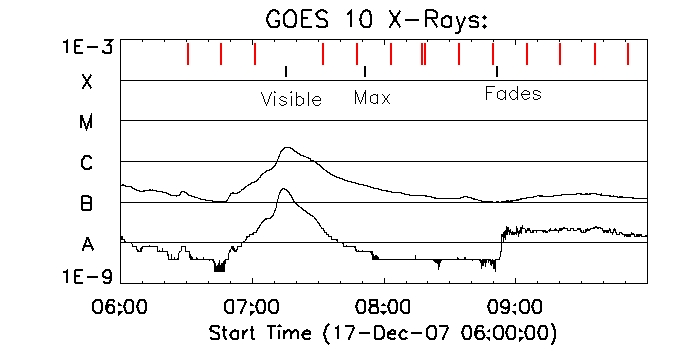
The original set of data was a set of 480 frames taken in a variety of 2 filter combinations. In order to run XRT Teem, the same restrictions were placed on the selected images as the previous data set. Of the 480 original images, there were only 28 images (or 14 pairs) which could be used. The time at which these images were taken can be seen on the graph. The time between each filter ratio is about 15 minutes. Here is a video of the prepped images which were used in the ratio test:

This video is contains all images which have one of the following filter ratios: Al_poly/Open, Al_poly/Ti_poly, C_poly/Open, or Be_med/Open. All of these images are used to show a more comprehensive video of the flare activity.
To create the temperature maps, two sets of filter wheel combinations were used: Al_poly/Open with Al_poly/Ti_poly or C_poly/Open with Be_med/Open. The result was a data cube containing 14 512 x 512 frames:

The maximum temperature recorded in this video is 7.363 (log scale) which is found in image 9 of 14. Similar to the data from 2007/12/18, the filters used for this image are C-band/Open and Be_med/Open. The image is not saturated in the middle. The jump in temperature accounts for the middle of the flare where the color scale is white (hottest). The others images’ maximums occur at about 7.2.
Because the flares were so short and the images are spaced by 15 minutes over 4 hours, the coverage of the flare isn’t complete. Only frame 2 (3 of 14) is in the flare. It is observed at 7:01 which is between the beginning and the maximum of the flare.
July 16
The XRT images were of solar activity on December 18th at 06:00 to 10:00. During this tme period, four flares occurred. The first flare began at 6:33, reached its maximum at 6:43, and ended at 6:53. The second begin at 6:54, reached its maximum at 7:01, and ended at 7:08. The third flare began at 8:55, reached its maximum at 9:00 and ended at 9:10. The final flare began at 9:36, reached its maximum at 9:40 and ended at 9:44. A fifth flare starts at 9:54 and reaches maximum at 10:00 but the end is not seen. The graph below shows the X-Ray activity on the sun during this time:
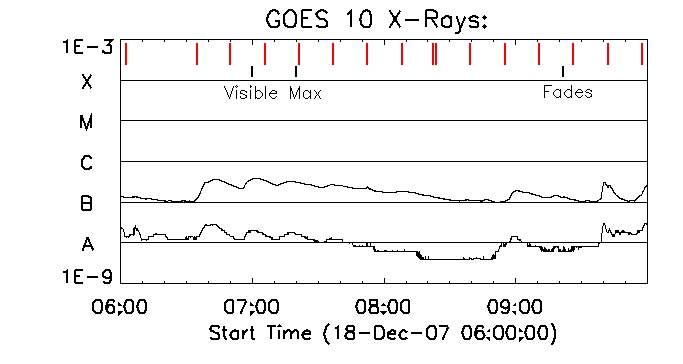
The original set of data was a set of 480 frames taken in a variety of 2 filter combinations. In order to run XRT Teem, the same restrictions were placed on the selected images as the previous data set. Of the 480 original images, there were only 32 images (or 16 pairs) which could be used. The time at which these images were taken can be seen on the graph. The time between each filter ratio is about 15 minutes. Here is a video of the prepped images which were used in the ratio test:

This video is contains all images which have one of the following filter ratios: Al_poly/Open, Al_poly/Ti_poly, C_poly/Open, or Be_med/Open. All of these images are used to show a more comprehensive video of the flare activity.
To create the temperature maps, two sets of filter wheel combinations were used: Al_poly/Open with Al_poly/Ti_poly or C_poly/Open with Be_med/Open. For this video, bin = 3 so that the current sheet could be easily seen. The result was a data cube containing 16 512 x 512 frames:

The maximum temperature in these images is 7.765 (log scale). It occurs in frame 8 (9 of 16 in video). While this is not an image during a flare, the saturation in the picture decrease so that the middle of the image has recorded temperatures which explains why the maximum temperature in this image is so much higher than those of other pictures. Most other pictures hover around 7.2. The minumum temperature is 5.56 (log scale).
Because the flares were so short and the images are spaced by 15 minutes, the coverage of individual flares isn't complete. In the video, the temperature map (and by extension, the current sheet) in images 2 and 3 are roughly the same size and reach the same temperature maximum7.24 and 7.26 respectively. Image 2 and image 3 both occur in between the maximum and end of flare one and two respectively. By image 4, the current sheet has started to decrease in size but the temperature maximum doesn't change (7.26). By Image 5, the ends of the flare can be easily recognized because the size and temperature decrease in images 5-7. These images are between recognized flares. The current sheet grows larger again in images 10-15 as the last two flares are observed.
July 13
A PDF of my midterm presentation can be found here.
July 7
I have continued to look at XRT data in order to create temperature maps using the filter ratio process. The XRT images were of solar activity on November 6th at 3:00 p.m. to 5:00 p.m. The flare began at 3:27 p.m., reached its maximum at 3:36 p.m., and ended at 3:44 p.m.The graph below shows the X-Ray activity on the sun during this time:
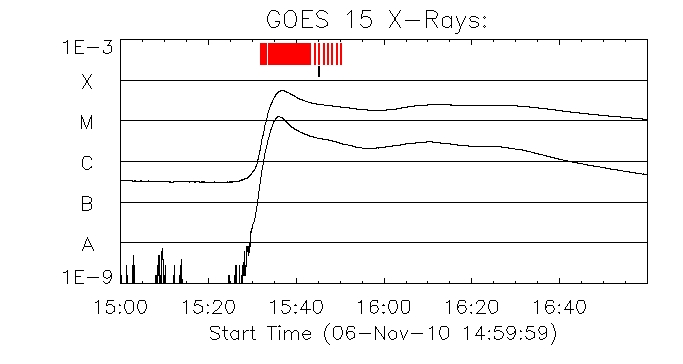
The original set of data was a set of 406 frames taken in a variety of 2 filter combinations. In order to run XRT Teem, the same restrictions were placed on the selected images as the previous data sets. Of the 406 original images, there were 76 images (or 38 pairs) which could be used. The time at which these images were taken can be seen on the graph. Here is a video of the prepped images which were used in the ratio test:

The first image in this set was not taken until 3:32 p.m. which means that the first 5 minutes of the flare were missed. While the entire data set had images of this part of the solar activity, the restricted set did not. However, the maximum of the flare can be seen and continues through completion. The last image in the set is taken at 3:50 p.m. after the flare has ended.
To create the temperature maps, images taken using the Open/Al_thick filter wheels combination were compared with those taken with Open/Be_thick and the difference time observed of the images was less than 10 seconds The result was a data cube containing 38 384 x 384 frames:

July 6
I have continued to look at XRT data in order to create temperature maps using the filter ratio process. The XRT images were of solar activity on September 23rd at 1:00 a.m. to 3:00 a.m. The flare began at 1:47 a.m., reached its maximum at 1:59 a.m., and ended at 2:10 a.m.The graph below shows the X-Ray activity on the sun during this time:
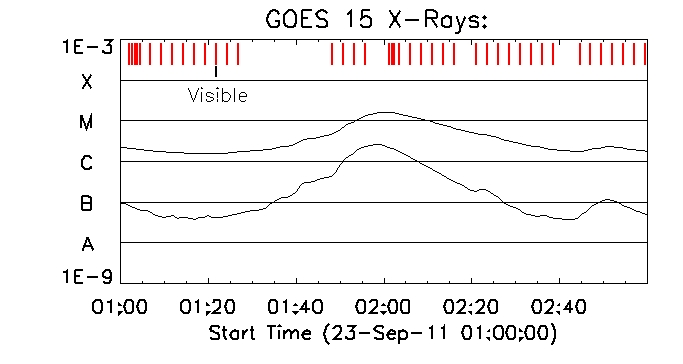
The original set of data was a set of 312 frames taken in a variety of 2 filter combinations. In order to run XRT Teem, the same restrictions were placed on the selected images as the previous data set. Of the 312 original images, there were 84 images (or 42 pairs) which could be used. The time at which these images were taken can be seen on the graph. Here is a video of the prepped images which were used in the ratio test:

The maximum of the flare is seen in this video because the images become saturated at the time when the flare was at it s maximum.
To create the temperature maps, three sets of filter wheel combinations were used: Open/Ti_Poly with Be_Thin/open, Open/Al_Thick with Open/Be_thick, and Open/Be_thick with Be_med/Open. The result was a data cube containing 42 384 x 384 frames:

From this video, we can see that the flare heats up near the the maximum because the colors change from oranges to reds and then begins to cool down after the flare as colors go back to orange. Also, right at the maximum, there is a large middle section which is either white or orange which should mean that this region is cooler than the area around it. By comparing this video to the video of the actual flare, this area is actually saturation. A similar problem was seen when analyzing the Open/Al_Mesh with Open/Ti_poly data on June 26th.
July 5
In a continuation of last week's work, I have continued to look at XRT data in order to create temperature maps using the filter ratio process. The XRT images were of solar activity on September 24th at 12:00 p.m. to 4:00 p.m. The flare occurred at 12:33 p.m. , reached its maximum at 1:20 p.m., and ended at 2:10 p.m. The graph below shows the X-Ray activity on the sun during this time:
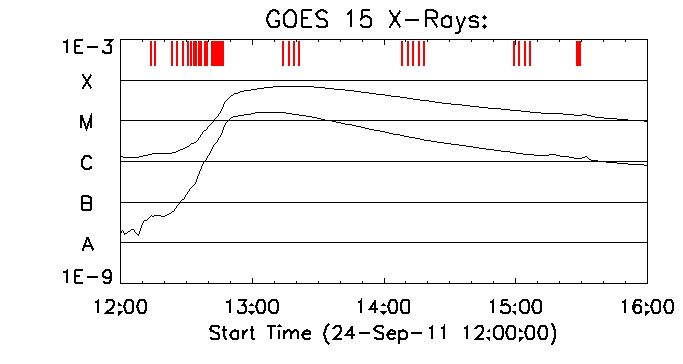
The original set of data was a set of 641 frames taken in a variety of 2 filter combinations. The combinations of filter wheel 1/filter wheel 2 in this set were Open/ti_poly, Open/Gband, Be_thin/Open, Open/Be_thick, Be_med/Open, Open/Al_thick, Al_med/Open, Al_poly/Open, Al_poly/Al_thick, and Al_med/Al_thick. In order to run XRT Teem, the following restrictions were placed on the selected images: the images must be taken in different filters, the size and resolution of the images must be the same, and the time between images must be less than 10 seconds. Of the 641 original images, there were 80 images (or 40 pairs) which could be used. The times at which these images were taken can be seen on the graph (red dashes denote image).
In the images used, only four combinations of filters were used to run XRT Teem. These filters were Be_thin/Open abd Open/Ti_Poly, Open/Al_thick and Open/Be_thick, Be_thin/Open and Open/Be_thick, and Open/Al_thick and Be_thin/Open. A movie of the produced temperature ratios can be found here:

June 26
This week, I've been working with XRT images of solar activity on November 4th, 2010 at 11:54 p.m. to November 5th, 2010 at 12:19 a.m. to find the average temperature using filter ratios. The flare occurred at 11:58 and ended at 12:12. This includes selecting the data, data prep(xrt_prep), data alignment (xrt_align_cube), and taking the ratio of the images (xrt_teem). XRT Teem uses two images of different filters taken of the same object in a short time frame to create a ratio of the images which can give information about the temperature and emission measure.
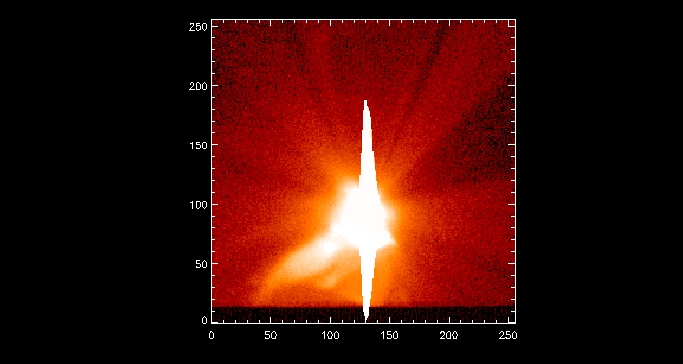
The first set of images compared was a set of 75 256 x 256 frames such that the first filter wheel was open and the second was either an aluminum mesh or Ti poly. The last image was not used because in order to run xrt_teem there must be pairs of images. The time step between the two images used in a pair was 3 to 5 second. Here is a sample image from the prepped data:
After using the ratio of the given image and the image prior to the given image in the time sequence, the temperature map was generated:
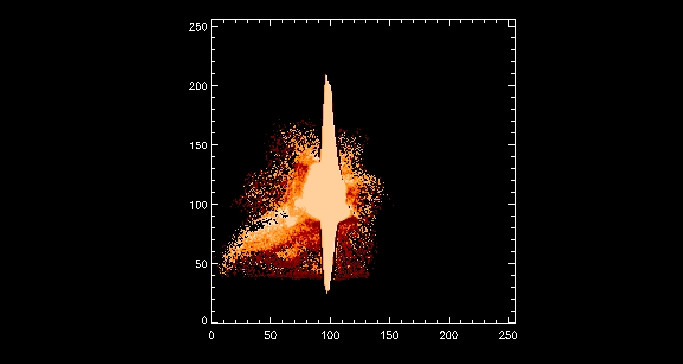
The new data cube contained 37 images. The next step will be to create a new index for these images.
Similarly, the process was performed on a set of 76 384 x 384 frames with an open first filter wheel and the second set on either thick Aluminum or thick Beryllium. The time step between two frames was 5 to 6 seconds. Here is a sample image from the prepped data:
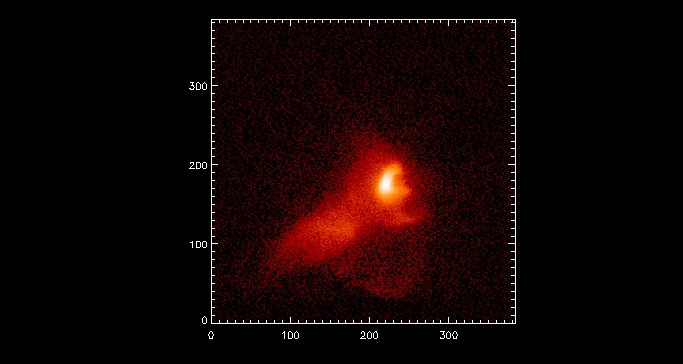 After xrt_teem was run, the resulting average temperature map was created:
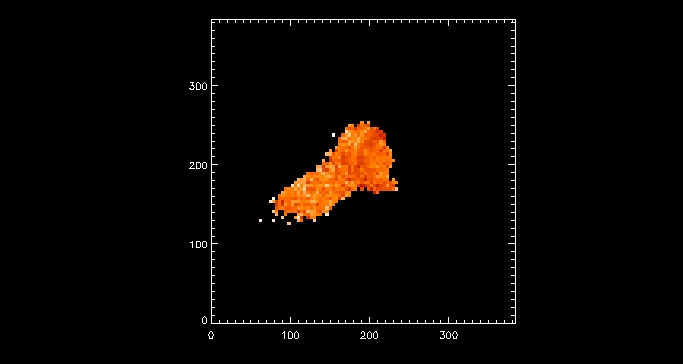
The new data cube used all 76 prepped images to create 38 new images.
The bright sheet can be seen in all the images. Over the time period of the images, the sheet gradually grows in size. The Al-mesh/Ti-Poly filters allow more light in and so there are more saturated images in the data. It is easier to see the growth of the sheet in the Al-thick/Be-thick images for this reason. Over time, the temperature increases over the duration of the flare and then begins to fall in the last images.
Note: There are thresholds in place for the ratio. If the signal from a given pixel is too low or the error for the pixel is too high, then the resulting temperature is thrown out. This is why not all the areas in the prepped image show up in the temperature map.
June 19
The original SXT data 1 was a set of 259 64 x 64 frames such that each frame either contained 2 or 4 different images. All frames were 2 seconds apart The goal of the project was to take these original frames and break each image up into separate frames to create a single, continuous set of images. The data was manually parsed by sections of image number according to the following series of for loops:
for 2 image frames:
for i= m, n do begin
new_data[*,*,2*i+x]=data[0:63,0:31,i]
new_data[*,*,2*i+x+1]=data[0:63,32:63,i]
endfor
for 4 image frames:
for j = n+1, p do begin
new_data[*,8:23,4*j+y+3]=data[0:63,48:63 ,j]
new_data[*,8:23,4*j+y+2]=data[0:63,32:47,j]
new_data[*,8:23,4*j+y+1]=data[0:63,16:31,j]
new_data[*,8:23,4*j+y]=data[0:63,0:15,j]
endfor
This created an array of 790 new images which were all 64 x 32. Because the images in the four image frames were only 64 x 16, the image was placed in the center. A new index was then created using similar for loops:
for indices of 2 image frames:
for i=m, n do begin
dummy=replicate(index[i],2)
new_index=[new_index,dummy]
new_index[2*i+x+1].gen.time=index[i].gen.time+1000
for indices of 4 image frames:
for j = n+1, p do begin
dummy=replicate(index[j],4)
new_index=[new_index, dummy]
new_index[4*j+y+1].gen.time=index[j].gen.time+500
new_index[4*j+y+2].gen.time=index[j].gen.time+1000
new_index[4*j+y+3].gen.[j].gen.time+1500
endfor
The time was changed in order to be more accurate. While in the original data set, each frame was 2 seconds apart, in the new data, the time between images was 1 second for frames with 2 images and only half a second for frames with 4 images. The serial number also had to be changed so that each image had a separate serial number. This was achieved using:
for i = 0, 789 do begin
new_index[i].sxt.serial_num=i
endfor
SXT_Prep was then run to correct the images. The same procedure was used to covert a series of 951 frames into a series of 2844 frames.
June 5
Today, I created this lovely website.