Lecture 15. B. Solar System Overview
 Physical Properties: details of particular objects, needed good telescopes and satellites to discover
- 9 planets, 60 moons, and lots of debris
- Four Inner (or Terrestrial) Planets: Mercury, Venus, Earth, Mars
- rocky & metallic -- hot,close Sun cooked away gas while forming
- AVERAGE
density*
of 3.9 - 5.7
- warmed by Sun
- few moons -- 1 for Earth, 2 for Mars
- no rings
- Four Gas Giants, or Jovian (="Jupiter like") Planets
- mostly hydrogen (H) & helium (He), with much ice -- from spectra!
- avg. density of .71 - 1.7
- GIANTS: though less dense, they're SO large,
they have much more mass
- more warmth from internal heat than Sun
-- high pressure in cores means high temperatures
- many moons -- 18 for Jupiter, 22 for Saturn, 18 for Uranus,
8 for Neptune
- all have rings
- Pluto -- oddball! -- will read for Monday...
- small size
- orbit inclined to ecliptic
- very large moon Charon, relatively
Dynamical Properties: known for long time -- any massive objects would behave similarly
- all planets orbit roughly w/in PLANE of ecliptic = solar system is FLAT
- all planets orbit the Sun counterclockwise from the North Celestial Pole
- most moons orbit around their planets equators, not poles
- the Sun and most planets rotate counterclockwise, spinning upright --
but Earth has a 23o tilt!
- most moons also spin counterclockwise
- most orbits are roughly circular, even though
Newton's Laws don't favor circular orbits
(orbits of strong eccentricity)
Titus-Bode rule does predict orbits, & planet at 2.8 AU
- asteroid belt there would've formed planet, but Jupiter's tugs prevented "accretion" (= formation of big ones from little ones by gravity)
Dating:
- Cratering: more craters = more impacts = been around to be hit longer
- assumptions about frequency of hits -- higher long ago?
- assumptions about removal of evidence of impacts -- weathering, volcanism
- Radiation: ratio of Parent & Daughter isotopes
(Lect. 11. B.*)
reveals how long parent has been decaying
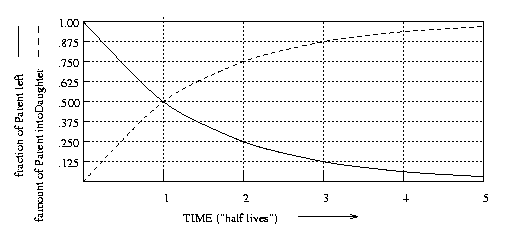
two curves above (Parent + Daugher) always add up to 1.00
-- amount of atoms is the same, only type of atoms has changed
Solar System Formation --
three theories*:
- haphazard accumulation -- chance captures of planets/planetesimals
- catastrophic origin -- another star collides with Sun,
gas dragged off forms Jupiter, etc.
- solar nebula -- accepted theory
- initially, a gas cloud
- gravity causes cloud to collapse
- conservation of angular momentum causes material to spin (=orbit)
- gravity flattens along axis of rotation
- planetesimals accrete
- VOILA! spins all match, material the same, and same age, etc.
- for images, check out this
great web page!*