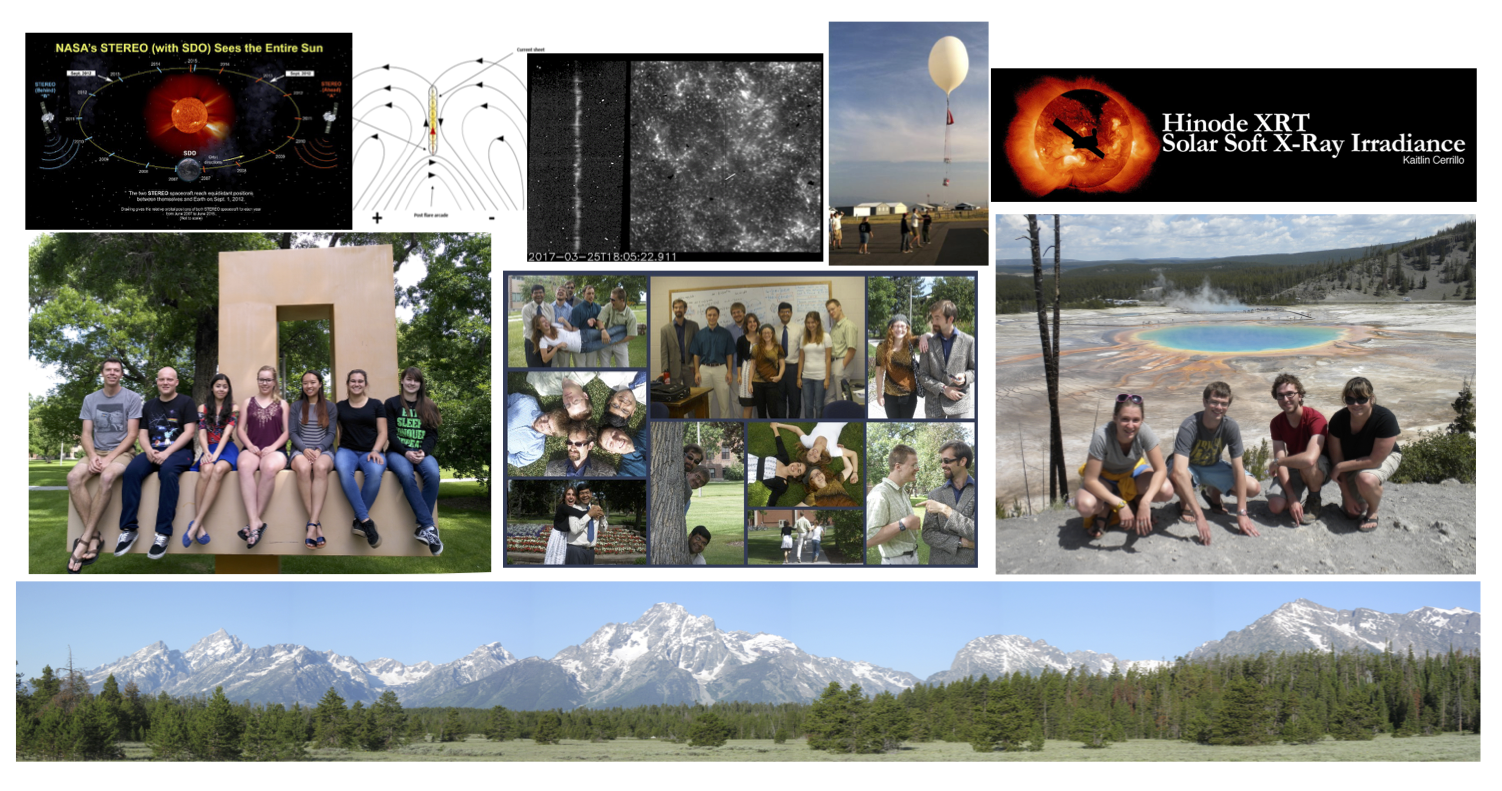
TRACE solar loops Magnetic field topological  model Bridger range from
Bozeman MOSES rocket payload Yohkoh sigmoid signature

REU 2008 flyer


REU 2008


REU 2007


REU 2006


REU 2005


REU 2004


REU 2003


REU 2002


REU 2001


REU Students' Journal Publications


REU Students' Conference Presentations


REU Students' Research Reports


MSU Solar Physics Group


MSU Physics Department


MSU


Bozeman


Contact Coordinators


The Solar REU program at MSU is sponsored in part by The National Science Foundation.


MSU Physics Department 

Solar Physics / Astronomy &
Space Physics REU Program 


Objectives
  • Provide high-quality state-of-the-art research experience.
  • Develop independence, creativity, and interest in physics and astronomy graduate study.
  • Demonstrate how academic knowledge acquired in classes relates to real-world research problems.
  • Develop and strengthen practical research skills.
  • Encourage participation by women and minorities in research.

Research

Most projects involve analysis of data from space missions such as Yohkoh, SOHO, TRACE, RHESSI and Hinode and ground-based observatories. Experience has shown that data analysis projects are suitable for most undergraduates at the sophomore or junior level.  Additionally, each year there are a few opportunities in the solar-stellar connection (dynamo theory, data analysis), solar magneto-hydrodynamics, and space hardware development.

Venue

The summer months in Montana offer outstanding opportunities for outdoor recreation and other activities associated with the university and the community. Surrounded by spectacular mountains and rivers, Bozeman is within easy driving distance of Yellowstone and Glacier National Parks.

Benefits

Our program gives participants an opportunity to develop skills for contemporary research under the guidance of internationally known physicists. These REU experiences help students make informed decisions about graduate school and careers in academia or research.

Training and Education

The first week of our program includes training in the unix/linux/Solaris computing environment and IDL as tools for numerical modeling and data analysis.  Lectures by MSU faculty and visiting professors cover a variety of subjects related to the research program. Participants are offered an opportunity to give public talks and lead star parties during two weekends in Yellowstone National Park. The last week of our program includes participant presentations of research results. The most successful projects lead to presentations at conferences and publications in journals. For a more detailed look at the program, see the calendars for 2007 and 2006.

Eligibility

Participants must be full-time undergraduates, typically finishing their sophomore or junior years. Applications from underrepresented groups are particularly welcomed. There are no restrictions with regard to citizenship. Foreign participants are supported from non-NSF sources.

Practical Details

The summer 2008 program will run from June 2 through August 8. Time-critical first and last week activities and summer housing limitations preclude other start and end dates. Stipends will be $4410 plus a $330 food allowance for the ten week program. Travel costs to and from Bozeman (up to coach air fare) from home or campus are covered and university residence hall lodging (single room) is provided. For non-US participants, support for travel costs is limited to the economy roundtrip airfare from JFK/New York.
 

REU Sample Project:

"Spatial Relationship between Twist in Active Region Magnetic Fields and Solar Flares"

Authors:    Michael Hahn, REU 2003 and 2004 participant (Physics major, Carnegie Mellon University) and Stacy Gaard, REU 2004 partipant (Meteorology major, Valparaiso University)  

Abstract:  Twisted magnetic field lines in solar active regions constitute stressed flux systems, the reconnection of which can release the stored (excess) magnetic energy in the form of solar flares. Using co-registered photospheric vector magnetograms and chromospheric H-alpha images for 29 flares, we explore the spatial relationship between these flares and the magnetic topology of the active regions in which they occur. We find two dominant trends. First, flares are preferentially initiated in subregions that have a high gradient in twist. Second, flare initiation occurs close to chirality inversion lines (which separate regions with twist of opposite handedness). Our results demonstrate that magnetic helicity, as manifested in the twist parameter, plays an important role in magnetic reconnection and solar flaring activity.

Mentors:   Dibyendu Nandi & Richard Canfield

This work is published in Astrophysical Journal.


What former REU students say about our program


"The Montana State University solar physics REU was an absolutely incredible experience. It really opened my eyes to the world of solar physics. My research area alone exposed me to a whole new vault of knowledge about the sun and it's magnetic field. The solar physics lectures expanded this knowledge to cover pretty much the entire sun! The most incredible part was being a part of the scientific process. No longer was I just studying material out of a book that had been proven a thousand times over. I was now applying this knowledge to the real world! The research was incredible, and so was Montana. The mountains were a bit sharper than the hills we have here in Georgia, and climbing them was the experience of a lifetime. In fact, I ended up staying for a week after the program to roam around Montana for a while. I would highly recommend this program to anyone who enjoys staring at the sun!"  

Chris Lowder, 2007 Participant
Physics major, Georgia Institute of Technology


"During my summer stay in the Solar REU program, I learned voluminous amounts. I picked up another programming language and learned about the biggest problems with our understanding of the sun. I feel like I even got a glimpse of what physics is all about, which has less to do with all the equations memorized from textbooks and more about trying with our little minds to understand nature in spite of its apparent desire to be utterly incomprehensible. The mentors were great and helped bring us into this world of current research. Trips to Yellowstone and Glacier National parks provided great weekend outings. Overall it was a great experience where I got to work really hard in something that was both challenging and rewarding, and in my free time I was allowed to enjoy the beautiful scenery of Montana. Anyone with any interest in understanding the mysteries of nature, and particularly the sun, would be lucky to take part in this program. "  

Nicholas Hill, 2007 Participant
Physics major, Grinnell College


"My Solar REU experience at MSU was an incredible opportunity. The mentors in the program were so supportive and encouraging and at the same time I was given a great deal of independence in my work. We were taught the tools we needed to be successful in our research and we continued to learn throughout the summer with various lectures and seminars. I learned so much in the course of only ten weeks. Not just about Solar Physics, but also new computer skills, learning to present my research, and even information about applying to grad school and being a graduate student. I also really enjoyed living in Bozeman for the summer. We took trips to Yellowstone, Glacier and the Beartooths along with other activities every weekend. I made some great friends in the program and was so pleased with my experience that it was hard to leave at the end of the summer."  

Emily McLinden, 2006 Participant
Physics major, Loyola University Chicago


"Go to Montana, work hard and have fun. My experience of the Solar REU was positive throughout. At work, we learnt rapidly and were soon given charge of our own research projects. I was fortunate to have a mentor who gave me both the independence I desired and the support I needed. He was also a good friend and our work was very rewarding. At play, I made a lot of friends from the Solar and other REU programs. Then there was Star Party, Glacier National Park, hiking, floating, climbing, soccer, Lost, bars, movies, kickball, Shakespeare, pizza, ice-cream..".  

Alexander Russell, 2006 Participant
Mathematics and Theoretical Physics major, University of St. Andrews, Scotland